
Solution
Robotic painting
A robot that learns the movement from the painter without programming – repeatable results even for small and medium batches.
- LESTA
In brief
Robotic painting is the painting of parts by a robot instead of manual spraying. LESTA painting robots learn by teach-by-demonstration: the operator paints a part once using the robot arm, and the robot records the movement and repeats it precisely – without conventional programming.
How it works
How a painting robot learns a new part
A LESTA robot learns the spray gun path in one of three ways: the painter performs it once with the robot arm, coats it once with a spray gun tracked by cameras, or a programmer prepares it in the computer on a 3D model of the part. The robot then repeats the program by itself.
Hand guiding (self-learning) – LEBOT MV A5 and MV A6 robots only: the motors are disengaged and the painter guides the robot arm.
Select a step or click a part of the diagram – we will show what it does, related terms, questions and products.
- Motion and recording
- Control and signal
Description of all parts
- Teaching mode
The painter switches on self-learning mode. The robot disengages its motors so that the arm can be guided freely by hand; its weight is supported by compressed air.
- Hand guiding
The painter guides the arm with the spray gun and performs the work cycle once, just as if coating the part manually.
- Hand guiding
The painter performs the work cycle once with the robot arm – making use of the painter's coating experience.
During teaching the motors are disengaged and the arm is supported by compressed air, so it is easy to guide. Low arm friction directly affects the quality and repeatability of the result. On a carriage, the robot "follows" the painter during recording (Follow Me). - GESTURE camera and spray gun with markers
Below the spray gun there is a handle with passive markers. The painter coats the first part manually and cameras record the 3D position of the markers – without the robot arm.
Recording does not depend on the robot arm, so it is also suitable for robots whose motors remain engaged – for example LEBOT DG. For particularly demanding applications, the manufacturer still recommends the self-learning LEBOT MV A6.
LESTA LEBOT DG → - PAINT STUDIO offline programming
A 3D model of the part, or of the entire booth, is loaded into the computer, spray gun paths are created and a simulation shows the robot's reach and the cycle time.
Meanwhile the robot can keep producing – programming does not stop the line. Key points of the path can also be recorded by physically moving the robot.
LESTA PAINT STUDIO →
- Hand guiding
- Motion recording
The robot records every movement in real time – on a carriage, including the travel along the rail.
- Path recording
The movement of the spray gun is saved as a path.
- Path recording
- Part program
The recording is saved as the part program. There is no need to write code or program paths – simply start the program.
- Part program
The path is saved as a program for the given part – without writing code. Programs can be called up by PRODUCTION MANAGER using a barcode or RFID tag.
LESTA automation and software →
LESTA PRODUCTION MANAGER →
- Part program
- Automatic coating
The robot repeats the program automatically, cycle after cycle.
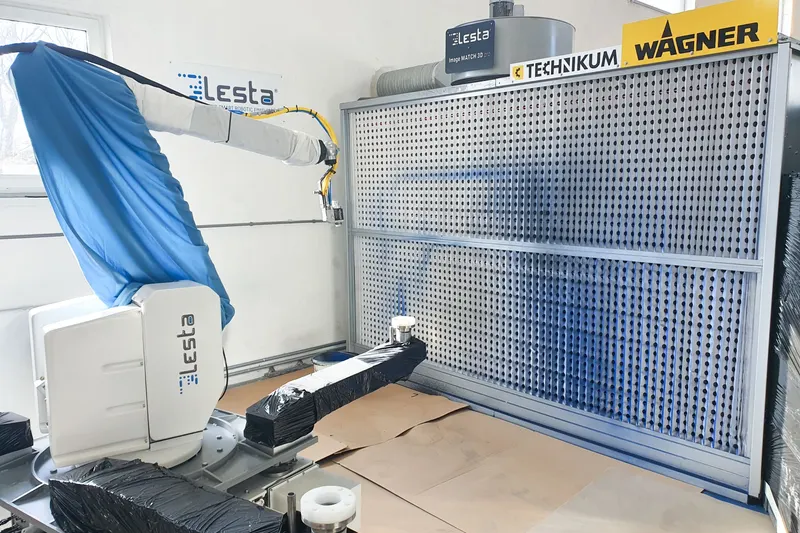
- Painting robot
LESTA painting robot. Only the LEBOT MV series is taught by hand guiding; LEBOT DG is taught with the GESTURE camera or in PAINT STUDIO; LEBOT I A6, C and WP are programmed offline. - Automatic coating of parts
The robot repeats the program automatically, cycle after cycle. For a new part, a new program is recorded.
- Painting robot
Simplified teaching principle. LEBOT C can also generate the path itself from a scanner (EasyPROG); LEBOT PICCHIO and WP are set up by entering points. We will design the teaching method and the connection to the spray gun, pump and conveyor to suit your production.
Source: LESTA – pages for the LEBOT MV A6, MV A5, DG (Italian website), I A6, C and WP robots, and the GESTURE and PAINT STUDIO accessories (lesta.it).
What we solve
Manual painting is slow and the result depends on the painter. A conventional robot is complex and expensive to program, so it does not pay off for small batches.
Who it is for
Paint shops for wood (doors, furniture), metal, plastics and laminates, manufacturers of large industrial products.
Technologies
- Teach-by-demonstration (learning by movement)
- ATEX environment
- Installation on the floor, a carousel or a conveyor
- Integration with WAGNER equipment
What we do for you
- Consultation and cell design
- Robot delivery and installation
- Electrical installation and wiring
- Operator training
Products for this field
- LESTA painting robots7 models
- LESTA automation and software7 models
Contact a technician
Patrik Pocisk
Sales and Marketing Director
- Phone – Patrik Pocisk: +421 905 855 000
- E-mail – Patrik Pocisk: pocisk@technikum.sk
- Patrik on LinkedIn
- Speaks: English, Slovak, Czech
Peter Kovár
WAGNER Sales Manager | SK & CZ
- Phone – Peter Kovár: +421 911 804 818
- E-mail – Peter Kovár: kovar@technikum.sk
- Speaks: Slovak, Czech
Martin Kyselica
Electrical Technician – LESTA robotic painting
- Phone – Martin Kyselica: +421 911 912 903
- E-mail – Martin Kyselica: kyselica@technikum.sk
- Speaks: English, Slovak, Czech
Videos
Presented by Peter Kovár, WAGNER Sales Manager for the Czech Republic and Slovakia. The video is in Slovak.
Automatic spray guns for robotsBase plate, robot mounting and seals of an automatic spray gun. Automatic spray guns for lines and robotsAutomatic spray guns for painting lines and robots, and parts for them.
Videos from our channel
WAGNER AquaCoat and GA 5000EAW gun on a robot – after a year of operationVideo from our YouTube channel – it only loads when you click. Watch on YouTube
In pictures
In practice
Articles and news
Frequently asked questions
How does robot teach-by-demonstration (self-teaching) work?
With teach-by-demonstration, the operator paints a part once and the robot records the movement in real time; it then repeats it precisely – without conventional programming.
Which materials does the robot paint?
According to the manufacturer, metal, wood, plastics, laminates (gelcoat) and more; both liquid and powder coatings.
Can the robot be programmed without teaching by hand?
A LESTA robot can also be programmed by offline programming on a computer from a 3D model of the part, with simulation of reach and cycle time – while the robot keeps working. See LESTA automation and software.
Can the robot paint parts on a moving conveyor?
A LESTA robot also paints parts on a moving conveyor, with conveyor synchronisation. It can also recognise parts and assign them a taught program.
What does the price of a LESTA painting robot depend on?
On the cell design: part sizes and robot reach, installation on the floor, a carousel or a conveyor, an ATEX environment, integration with WAGNER equipment and software, electrical installation and wiring, and operator training. We will send the exact price in a quotation after your enquiry.
Who services LESTA robots?
TECHNIKUM carries out service of LESTA robots with its own technicians; the team includes an electrical engineer for robotic painting.
Have a different question? Write to us – a technician will answer. Send an enquiry
Technical terms are explained in the glossary.
Related solutions
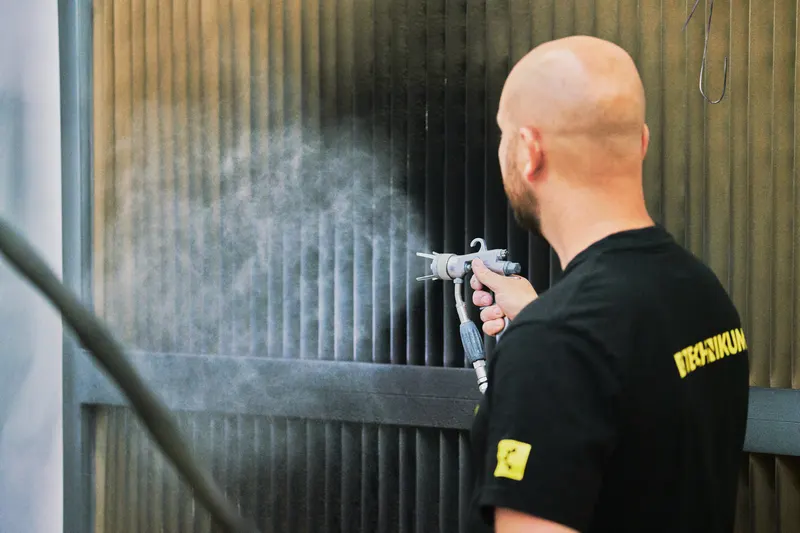
Industrial coating
WAGNER and WALTHER PILOT spray pumps, spray guns and 2K systems – from a manual workstation to a coating line.
- WAGNER
- WALTHER PILOT
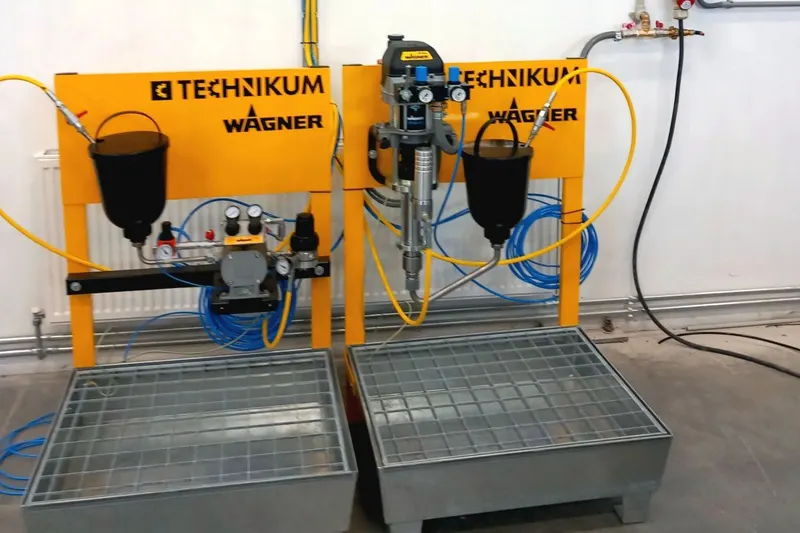
Industrial installation
We connect new technology and modify existing equipment: piping, valves, automatic spray guns, control systems and electrical installation – from design to commissioning.