
IST
IST vacuum evaporators
Vacuum evaporators for treating industrial waste water. According to the manufacturer, they recover up to 95 % of the water as reusable distillate.
Send an enquirySolution: Solvent recyclingCompare models in the table
Models (2)
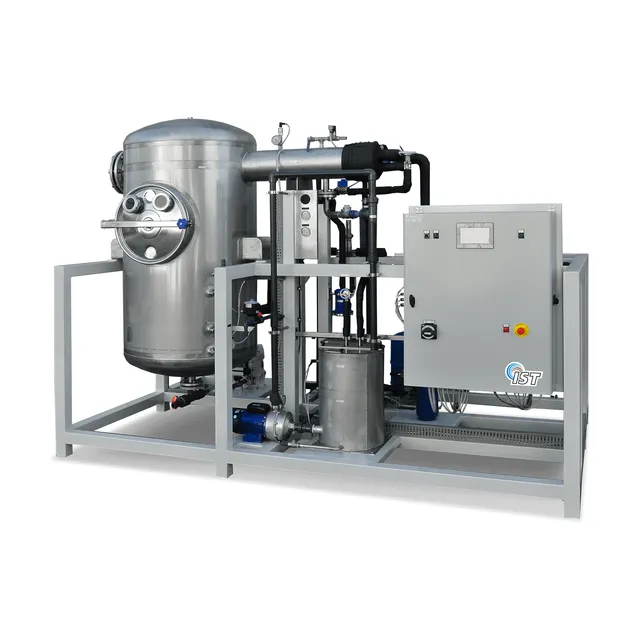
IST-WE Series
Compact IST WE vacuum evaporator with heat pump for treating industrial wastewater – 240 – 2,640 l/24 h.
- Distillation output
- depending on version
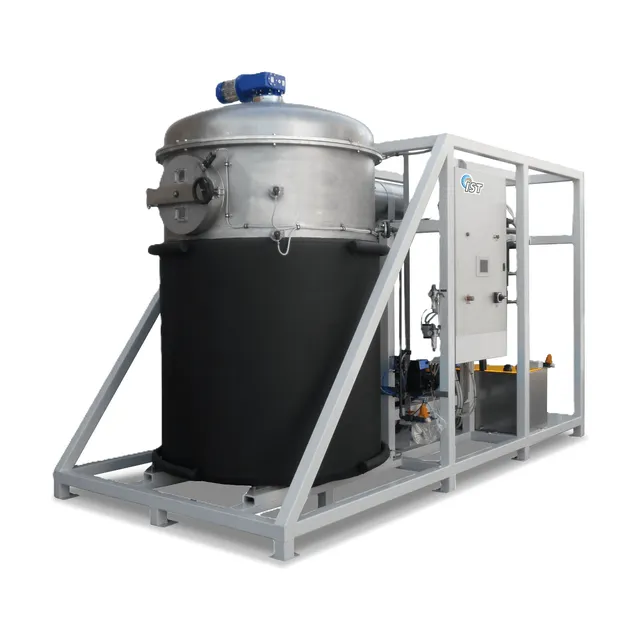
IST-WE-S Series
IST WE-S vacuum evaporator for complex and heavily contaminated wastewater – jacketed heat exchanger and automatic scraper, 240 – 6,000 l/24 h.
- Distillation output
- depending on version
Also searched as: evaporator, evaporators, vacuum evaporator, waste water
How it works
How a vacuum evaporator works
Under vacuum, the waste water evaporates at a lower temperature. The vapour condenses into clean water and the contaminants remain in the boiler as concentrate. The heat from condensation is returned to the evaporation process.
Select a step or click a part of the diagram – we will show what it does, related terms, questions and products.
- Contaminated liquid
- Negative pressure (vacuum)
- Residue for disposal
- Vapour
- Heat
- Water
Description of all parts
- Intake
The vacuum system lowers the boiling point of the water and automatically draws the waste water into the boiler.
- Waste water
For example, wash water from water-based paints. - Vacuum system
Lowers the boiling point of the water and draws the waste water into the boiler.
- Waste water
- Evaporation
The heat exchanger transfers heat to the liquid in the boiler; the water evaporates and the contaminants remain. The heat source is a heat pump.
- Evaporator boiler
This is where the water evaporates and the contaminants remain. The WE series has a heat exchanger immersed in the liquid, the WE-S series a jacket heat exchanger around the boiler and an internal scraper – also suitable for sludges and thicker liquids.
No chemicals are added to the water – unlike flocculation, the salt content does not increase and the quality does not depend on changes of paint or formulation. Some waters need a small dose of antifoam, which remains in the concentrate. - Heat pump
Supplies heat to the heat exchanger and recovers the heat released when the vapour condenses.
- Evaporator boiler
- Condensation
The vapour condenses into distillate. The heat pump returns the heat from condensation to the evaporation process.
- Condenser
Here the vapour condenses into distillate. In the WE series it is located in the upper part of the boiler.
- Condenser
- Clean water
The distillate – clean water – can be reused, for example for cleaning or thinning.
- Distillate – clean water
Clean water for reuse in the process.
The distillate has low conductivity and very few solids – without reverse osmosis.
- Distillate – clean water
- Concentrate
The concentrated residue remains in the boiler and is handed over for controlled disposal.
- Concentrate
The concentrated residue left in the boiler goes for controlled disposal.
The concentrate contains pigments, resins, salts and most of the dissolved substances – it is a small fraction of the original volume.
- Concentrate
Simplified principle, not the layout of a specific model. We assess suitability for a particular waste water on the basis of a sample.
Source: IST – industrial evaporator pages and an article on recycling waste water from water-based paints (ist.it).
Model comparison
| Model | Distillation output | Output | recovering up to 95% of the water |
|---|---|---|---|
| IST-WE Series | by version | by version | up to 95 % |
| IST-WE-S Series | by version | 5 – 57 kW | up to 95 % |
Data are taken from manufacturer documentation. We will verify them for your application before you order.