Article
How solvent recycling by distillation works
Published
Contaminated solvent from cleaning guns and equipment does not all have to end up as waste. A distillation unit separates clean solvent from it for reuse.

How distillation works
- The contaminated solvent is filled into the boiler and heated above its boiling point – the boiler is heated by thermal oil in the jacket.
- The solvent evaporates before the contaminants, and the vapours pass into the condenser.
- In the condenser the vapours are cooled and condense back into liquid.
- The clean solvent is ready to be reused – distillation is a physical process and does not change the chemical properties of the solvent.
- The residue (pigments, resins) remains in the boiler – it is drained and disposed of as waste.
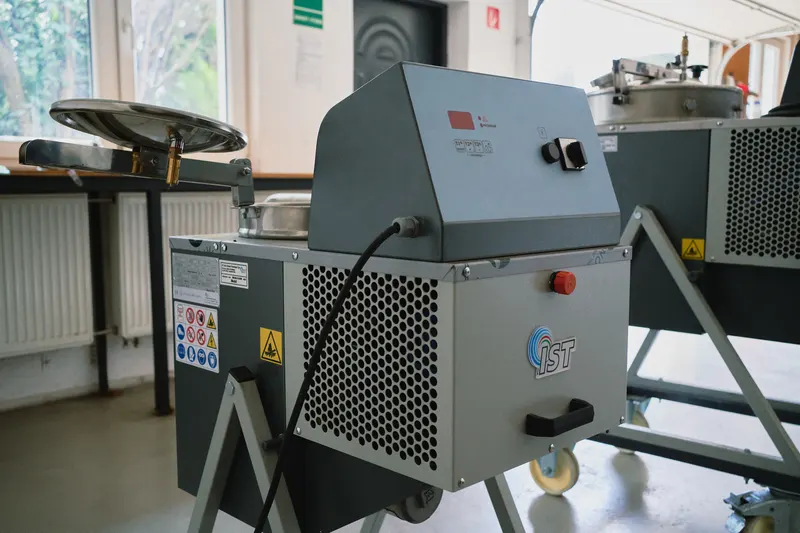
This is how the IST distillation units we sell and service work. The process is explained in more detail under the term solvent distillation in the glossary.
What remains after distillation
The distillation residue is disposed of as waste, but in a much smaller volume than the original contaminated solvent.
High-boiling and heat-sensitive solvents
In vacuum distillation, the pressure in the unit is reduced so that the solvent boils at a lower temperature. It is used for high-boiling or heat-sensitive solvents. The vacuum is generated by a vacuum pump or a Venturi system.
Safety: ATEX environment
Solvent distillation is a typical potentially explosive environment covered by ATEX rules. When choosing a unit, you therefore need to know where it will be installed.
What we need to know from you
Which solvent you use, how much of it you contaminate per week or month and what it is contaminated with. Based on this, we will propose the unit size for your solvent recycling.
Is this an issue in your plant?
Tell us what you need – the technician for your area will get back to you.
Your technician
Lukáš Rybár
IST Manager – solvent recycling
- Phone – Lukáš Rybár: +421 948 855 000
- E-mail – Lukáš Rybár: rybar@
technikum.sk - Lukáš on LinkedIn
- Speaks: English, Slovak, Czech
Your technician
Lukáš Rybár
IST Manager – solvent recycling
- Phone – Lukáš Rybár: +421 948 855 000
- E-mail – Lukáš Rybár: rybar@
technikum.sk - Lukáš on LinkedIn
- Speaks: English, Slovak, Czech