
WAGNER

WAGNER GM 5020
WAGNER GM 5020 electrostatic manual spray guns for water-based paints and release agents – Airspray (EAW) and AirCoat (EACW).
Who it is for: Metal coating, Plastic coating, Wood coating
- 8–250 barPressure (depending on version)
- 580 gWeight
Enquire about this productBring your paint – we will test it
The technician for your field will contact you as soon as possible. Prices are provided in our quotation.
Why WAGNER GM 5020
- Even coatingThe homogeneous electrostatic field delivers a very even film thickness and better atomisation.
- Wrap-around of the partThe charged paint is attracted from all sides to the earthed part – depending on the shape, it is sometimes enough to spray from one side only.
- ATEX safetyThe guns comply with CE and ATEX Zone 1; the control unit monitors the gun earthing and switches off the high voltage if it is interrupted.
- Durable electrodeThe flexible, durable electrode directly at the nozzle keeps its shape even under heavy load and ensures a constant material charge.
The GM 5020 is a range of electrostatic manual spray guns with internal charging and a built-in high-voltage cascade, designed for water-based paints and release agents. The GM 5020EAW is for Airspray (up to 8 bar), the GM 5020EACW for AirCoat (up to 250 bar).
Applications: waterborne paints, release agents, Airspray, AirCoat
Source of text: manufacturer’s brochure (PDF, in English), manufacturer’s page
Versions
Common to all versions
- Application area
- Metal coating, Plastic coating, Wood coating
- Material Wetted Parts
- Stainless steel, Carbide, PA 12 (polyamide 12), PEEK (Polyetheretherketone), POM-C (Polyacetal Copolymer)
| Version | Technology | Materials | Pressure | Operating temperature | Weight | Compressed air connection | Max. Sound Level |
|---|---|---|---|---|---|---|---|
| GM 5020EACW | AirCoat, Electrostatic water-based | Water-borne, shear sensitive, Abrasive | 250 bar | 5-40 °C | – | – | – |
| GM 5020EAW | Airspray, Electrostatic water-based | Water-borne, shear sensitive, sensitive to moisture | 8 bar | – | 580 g | M G 1/4'' | 78 dB(A) |
Data are taken from manufacturer documentation. We will verify them for your application before you order. Request a technical data sheet
Accessories for this equipment
According to manufacturer documentation. We will select the exact version (bore, pressure, length) with you based on the equipment and material.
WAGNER spray pumps and packages
WAGNER flushing, mounting and other accessories
Compatible with
According to manufacturer documentation. We will select the exact version (bore, pressure, length) with you based on the equipment and material.
WAGNER spray pumps and packages
How it works
How electrostatic spraying works
A high-voltage cascade in the spray gun gives the paint droplets a negative charge. The part is earthed, so the charged droplets are attracted to it – they travel along the field lines, land evenly and also reach the back of the part. This saves material.
Water-based paints are conductive – the entire system (spray gun, hose, pump, container) is live. It must therefore be insulated, for example in an AquaCoat cabinet, and the container may only be accessed after complete discharge.
Select a step or click a part of the diagram – we will show what it does, related terms, questions and products.
- High voltage
- Paint / material
- Field lines (charged droplets)
- Earthing
Description of all parts
- Control unit
The control unit powers the spray gun, sets the voltage and current (recipes) and monitors the earthing. If it is interrupted, it switches off the high voltage.
- Control unit
VM 500 and VM 5000 control GM 5000EA/EAC manual spray guns, VM 5020 spray guns for water-based paints, EPG 5000 GA 5000 automatic spray guns. They monitor the earthing and switch off the high voltage if it is interrupted.
They have voltage and current recipes and a service interval based on spraying time. EPG 5000 also controls the compressed air, varies the voltage according to an external signal and also switches it off during flushing.
VM 500 →
VM 5000 →
VM 5020 →
EPG 5000 → - Material and air supply
Electrostatic application is used with air spraying, AirCoat and rotary bells. The lower the material and air pressure, the better the electrostatic effect; it is not suitable above 250 bar.
WAGNER spray pumps and packages → - AquaCoat insulated system
A fully insulated system for water-based paints and release agents. During spraying, access to the interior is mechanically locked and the most important safety devices are duplicated.
AquaCoat →
- Control unit
- Cascade in the spray gun
A high-voltage cascade in the spray gun generates the high voltage.
- Electrostatic spray gun: GM 5020
The spray gun contains a high-voltage cascade and an electrode. On the GM 5000EAC, a flexible electrode charges the material directly at the fluid nozzle.
- Electrostatic spray gun: GM 5020
- Droplet charging
The electrode gives the paint droplets a negative charge. The charged droplets repel each other, so they spread out evenly.
- Charged droplets and field lines
The droplets travel along the field lines to the earthed part. The field lines concentrate on edges and corners – these are well covered, but there is a risk of the “picture frame effect”; in that case, reduce the voltage.
- Charged droplets and field lines
- Earthed part
The earthed part attracts the droplets – they travel along the field lines and land perpendicularly. Conductive parts, such as metal, are best.
- Part on hanger
Conductive parts (metal) are the most suitable. Wood needs sufficient moisture; plastics and glass need special preparation, such as a conductive primer.
Electrostatic application does not reach cavities and the inside of the part (Faraday effect) – there it has to be switched off briefly or the pressure increased. - Earthing
Joints, earthing leads and hangers must be clean – paint build-up interrupts the earthing. If the part is not earthed, the best-earthed “part” is the sprayer, and the paint goes onto them.
- Part on hanger
- Wrap-around
The field lines wrap around the part, so the paint also settles on its back – especially with grid-like and round parts.
- Wrap-around
The paint also reaches the back of the part – the greatest material savings are achieved with grid-like and round parts.
- Wrap-around
Simplified principle. External charging (electrodes outside the spray jet) is used mainly with rotary bells. We select the control unit, spray gun and insulation according to the paint, the parts and the zone.
Source: WAGNER – electrostatic spraying of liquid paints, VM 500, VM 5000, VM 5020, EPG 5000 control unit and AquaCoat pages (wagner-group.com); WALTHER PILOT – WaltherWiki.
Video
Presented by Peter Kovár, WAGNER Sales Manager for the Czech Republic and Slovakia. The video is in Slovak.
Electrostatic application: parts and serviceElectrostatic spray guns, high-voltage cables and their service.
Similar models – WAGNER spray guns and atomisers
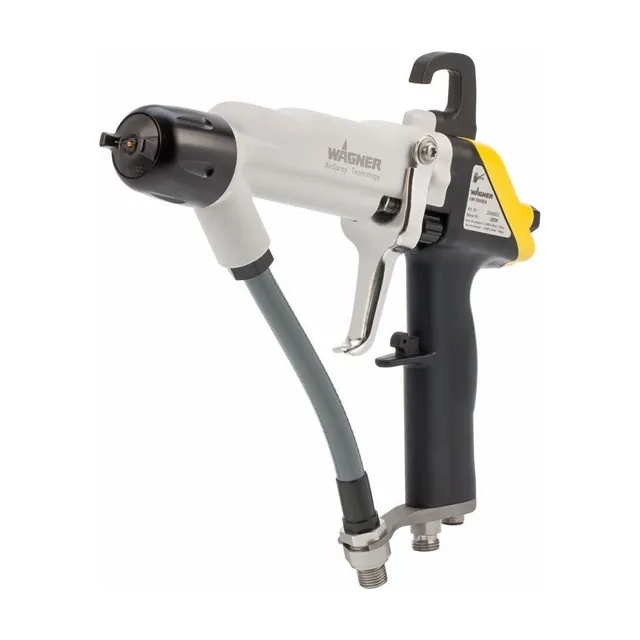
WAGNER
GM 5000
WAGNER GM 5000 electrostatic manual spray guns for solvent-based paints – Airspray (GM 5000EA) and AirCoat (GM 5000EAC) with integrated cascade.
8 – 250 barPressure
- Technology
- depending on version
- Weight
- 630 – 710 g
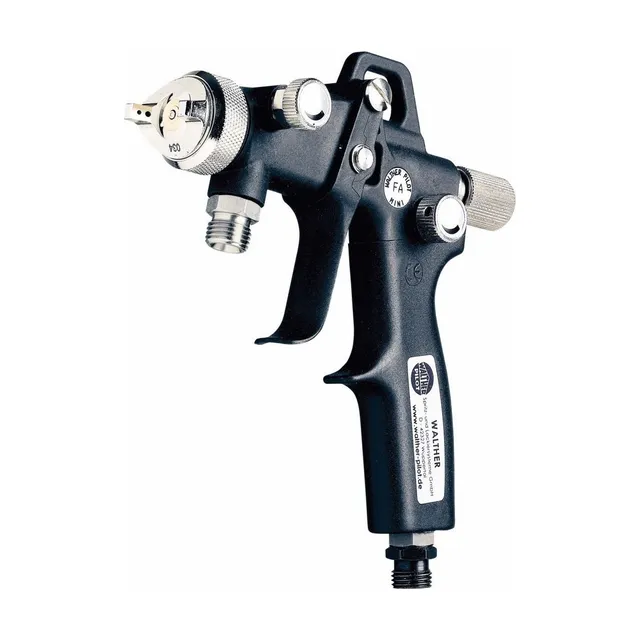
WAGNER
Pilot Mini
Extremely lightweight PILOT Mini Airspray manual spray gun made of high-strength plastic for small parts, repairs and decorative work.
8 barPressure
- Technology
- Airspray, Airspray - Conventional, Airspray - HVLP-Plus, Manual coating
- Weight
- 279 – 379 g
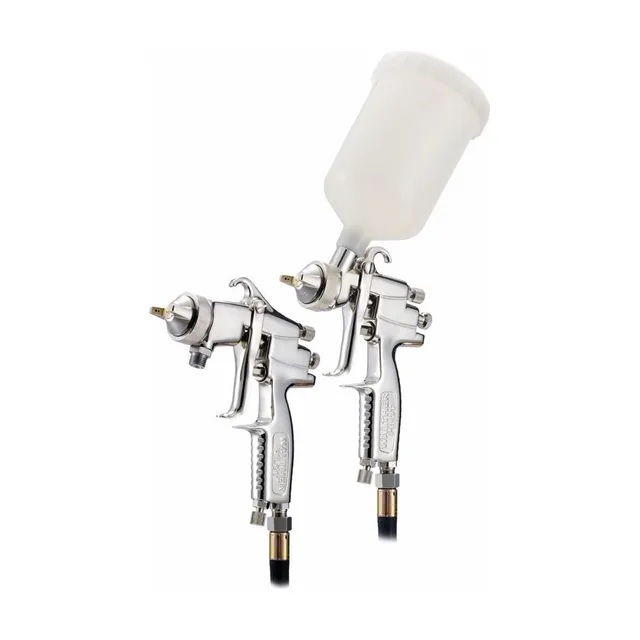
WAGNER
Pilot Trend
Affordable, versatile PILOT Trend Airspray manual spray gun with proven air cap technology – with a cup or with a material feed.
8 barPressure
- Technology
- Airspray, Airspray - Conventional, Airspray - HVLP, Manual coating
- Weight
- 482 – 677 g
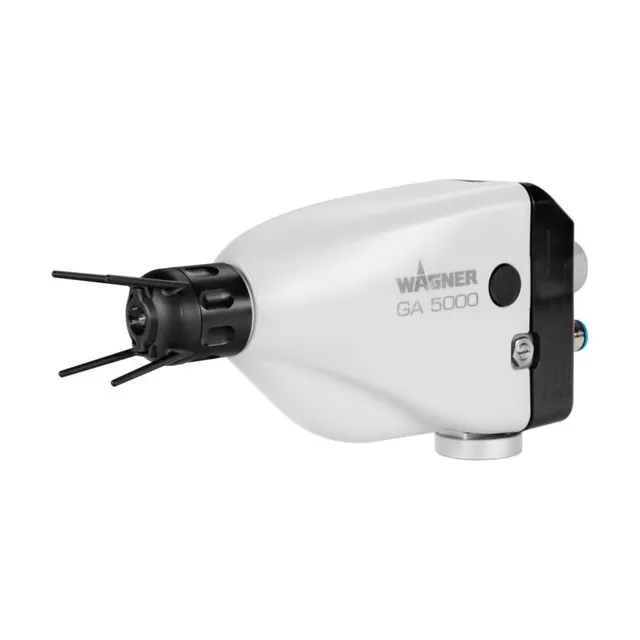
WAGNER
GA 5000
WAGNER GA 5000 electrostatic automatic spray guns for solvent-based and water-based paints – Airspray up to 8 bar and AirCoat up to 250 bar.
8 – 250 barPressure
- Technology
- depending on version
- Weight
- 1,000 – 1,200 g
Frequently asked questions
What is the maximum material pressure of the WAGNER GM 5020?
- GM 5020EACW
- According to the manufacturer's technical data for the WAGNER GM 5020EACW: maximum material pressure 250 bar.
- GM 5020EAW
- According to the manufacturer's technical data for the WAGNER GM 5020EAW: maximum material pressure 8 bar.
Which materials can the WAGNER GM 5020 process?
- GM 5020EACW
- According to the manufacturer's technical data for the WAGNER GM 5020EACW: materials: water-based, shear-sensitive, abrasive.
- GM 5020EAW
- According to the manufacturer, materials: water-based, shear-sensitive, moisture-sensitive.
What is the WAGNER GM 5020 designed for and which spraying methods does it use?
- GM 5020EACW
- According to the manufacturer, application method: AirCoat, electrostatic application – water-based materials; applications: metal, plastics, wood.
- GM 5020EAW
- According to the manufacturer, application method: Airspray, electrostatic application – water-based materials; applications: metal, plastics, wood.
What materials are the paint-wetted parts of the WAGNER GM 5020 made of?
- GM 5020EACW
- According to the manufacturer, the paint-wetted parts of the WAGNER GM 5020EACW are made of the following materials: stainless steel, tungsten carbide, polyamide PA 12, PEEK, polyacetal POM-C.
- GM 5020EAW
- According to the manufacturer, the paint-wetted parts of the WAGNER GM 5020EAW are made of the following materials: stainless steel, tungsten carbide, polyamide PA 12, PEEK, polyacetal POM-C.
Which nozzle sizes does the WAGNER GM 5020 take?
According to the manufacturer's technical data for the WAGNER GM 5020EAW: nozzle size 0.3–2 mm.
What connections does the WAGNER GM 5020 require?
According to the manufacturer's technical data for the WAGNER GM 5020EAW: air connection male thread G 1/4″.
How much does the WAGNER GM 5020 weigh and how loud is it?
According to the manufacturer's technical data for the WAGNER GM 5020EAW: weight 580 g; max. noise level 78 dB(A).
Have a different question? Write to us – a technician will answer. Send an enquiry
Technical terms are explained in the glossary.