
IST
IST ECO PLUS 202-400
Expandable IST ECO PLUS 202-400 solvent recovery unit in ATEX II2G version for continuous operation – up to 2,000 l of contaminated product per day.
Who it is for: regeneration of used solvents, paint shops and painting lines, printing works, paint and varnish manufacturing, large and small operations running continuously
- 200–400 lLoading capacity (depending on version)
- 200–2,000 l/24 hDistillation output
- 12–22 kWOutput (depending on version)
Enquire about this productSend a solvent sample – we will test the recycling
The technician for your field will contact you as soon as possible. Prices are provided in our quotation.
Why IST ECO PLUS 202-400
- No operator supervisionFully automatic operation; guided programming even for the most complex mixtures.
- Entire process automaticOptional tanks automate filling and discharge; the unit is easily integrated into existing operations.
- Overview of resultsDISTI-Link records and evaluates productivity, processing costs and savings and allows the settings to be fine-tuned.
- Less downtimeAutomatic reminders for routine maintenance.
- Less heating maintenanceLow specific heater output reduces maintenance and keeps performance stable over time.
- Small footprintCompact dimensions save production space.
ECO PLUS is an expandable solvent recovery unit designed for continuous operation and easy connection to other equipment. It processes up to 2,000 l of contaminated product per day; heating is provided by a static oil system with diathermic oil and a vacuum pump. Operation is fully automatic without operator supervision, and the unit is plug & play. It is controlled by the DISTI-Touch PLC with a colour graphic display and touch keypad, on which the operator can safely carry out all operations and cycle settings. All process parameters are shown on the touchscreen, and programming is guided even for complex mixtures. The unit can be supplemented with tanks to automate the entire process and with DISTI-Link, which monitors productivity, costs and savings and reports routine maintenance. It is available in the sizes ECO PLUS 202 and ECO PLUS 400.
Source of text: manufacturer’s brochure (PDF, in English)
Technical data
- Distillation output
- 200–2,000 l/24 h
- Explosion protection
- ATEX II2G
Versions
| Version | Output | Loading capacity | Distillation output |
|---|---|---|---|
| ECO PLUS 202 | 12 kW | 200 l | 200–1 000 l/24 h |
| ECO PLUS 400 | 22 kW | 400 l | 400–2 000 l/24 h |
Data are taken from manufacturer documentation. We will verify them for your application before you order. Request a technical data sheet
How it works
How solvent distillation works
The contaminated solvent is heated in the boiler, its volatile fraction evaporates, turns back into a liquid in the condenser and flows out as clean solvent. The contaminants remain in the boiler as residue.
Select a step or click a part of the diagram – we will show what it does, related terms, questions and products.
- Contaminated liquid
- Negative pressure (vacuum)
- Heat
- Residue for disposal
- Vapour
- Cooling
- Clean liquid
Description of all parts
- Filling
The contaminated solvent is filled into the boiler – depending on the machine, manually, with a filling kit or automatically from a storage tank.
- Contaminated solvent
Solvent contaminated with paints, resins and the like – for example from cleaning spray guns and containers.
- Contaminated solvent
- Heating and evaporation
Thermal oil transfers heat to the boiler. The volatile fraction of the solvent evaporates; the less volatile contaminants remain in the boiler. Some series operate under vacuum.
- Vacuum (some series)
In some series (IST 90, IST 202, ECO PLUS, ROTO PLUS, HR), a vacuum pump lowers the boiling point of the solvent. IST uses a liquid-ring vacuum pump.
A lower boiling point means less thermal stress – suitable for high-boiling and heat-sensitive solvents. For nitrocellulose paints, IST recommends vacuum distillation. - Distillation unit boiler: ECO PLUS 202-400
A sealed boiler in which the solvent evaporates and the contaminants remain. Some series have an agitator with scrapers that keeps the boiler walls clean.
Distillation only changes the physical state – the chemical properties of the solvent are retained, so it can be distilled repeatedly. IST has replaced the PTFE coating with a surface treatment of the boiler that is similarly non-stick and more wear-resistant.
How solvent recycling by distillation works → - Thermal oil heating
Heat is transferred to the boiler by thermal (diathermic) oil – not by a direct flame or a heating coil in the solvent.
According to IST, oil heating is more efficient than steam or hot water. Smaller machines use static oil; the HR series has a modulating heater with an oil circulation pump.
- Vacuum (some series)
- Condensation
The vapours pass into the condenser, which removes their heat – the solvent returns to liquid form. The condenser is cooled by air or water.
- Condenser
Removes heat from the vapour so that the solvent turns back into a liquid.
The condenser material must be compatible with the solvent being distilled. - Air or water cooling
An air-cooled condenser depends on the room temperature and ventilation; a water-cooled one allows more stable conditions.
- Condenser
- Clean solvent
The condensed solvent is collected in a container. Whether it is suitable for reuse depends on its composition and on the process in which it is to be used.
- Clean solvent
The distillate is collected in a container and can be reused, for example for cleaning.
Less new solvent and less waste – and less dependence on suppliers.
- Clean solvent
- Residue
At the end of the cycle, the concentrated residue is removed from the boiler – depending on the machine, by tilting the boiler into a bag, via a valve or automatically.
- Residue for disposal
The concentrated residue (sludge) from the boiler is disposed of as waste. Its volume is much smaller than that of the original contaminated solvent.
The residue consists of resins, polymers, metals and other non-volatile substances; depending on its composition, it is hazardous waste. It is emptied by tilting the boiler into a bag (IST C, 32–62), via a valve (IST 90, 202) or automatically (HR).
- Residue for disposal
Simplified principle, not the layout of a specific model. The filling, emptying and cooling method, and whether the machine operates under vacuum, vary by series – we specify them in our quotation.
Source: IST – description of the distillation process in 5 steps and the distillation unit pages (ist.it).
Similar models – IST distillation units
IST
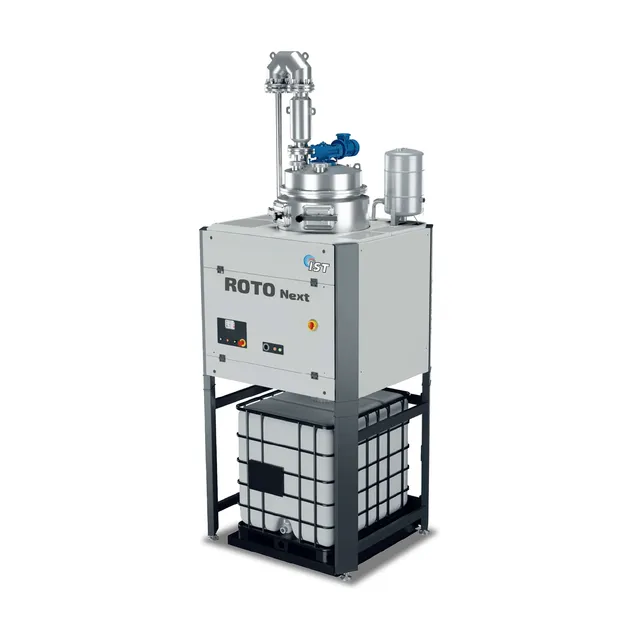
ROTO NEXT 100-202-400
IST ROTO NEXT 100-202-400 solvent distillation unit in ATEX II2G design – successor to ROTO PLUS with gravimetric filling and insulated vessel, 100 – 2,000 l/24 h.
100–2,000 l/24 hDistillation output
- Loading capacity
- 100 – 400 l
IST
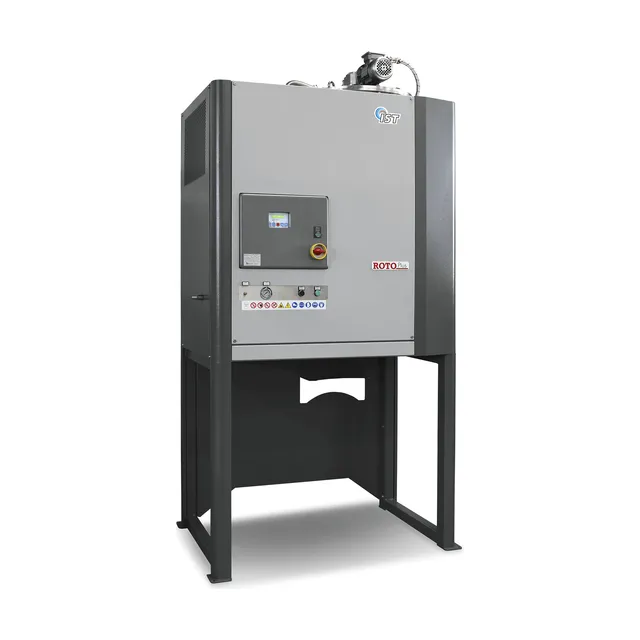
ROTO PLUS 100-202-400
Modular self-cleaning IST ROTO PLUS 100-202-400 solvent distillation unit in ATEX II2G design – automatic unattended operation, 100 – 2,000 l/24 h.
100–2,000 l/24 hDistillation output
- Loading capacity
- 100 – 400 l
IST
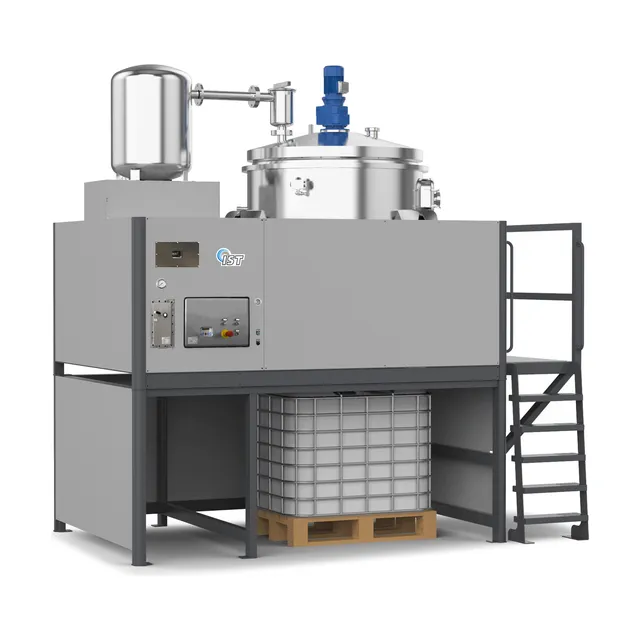
HR 600-1200
Fully automatic IST HR 600 / HR 1200 vacuum solvent recovery unit for industrial operations – continuous distillation including filling and sludge discharge.
600–10,000 l/24 hDistillation output
- Loading capacity
- 1,200 – 580 l
IST
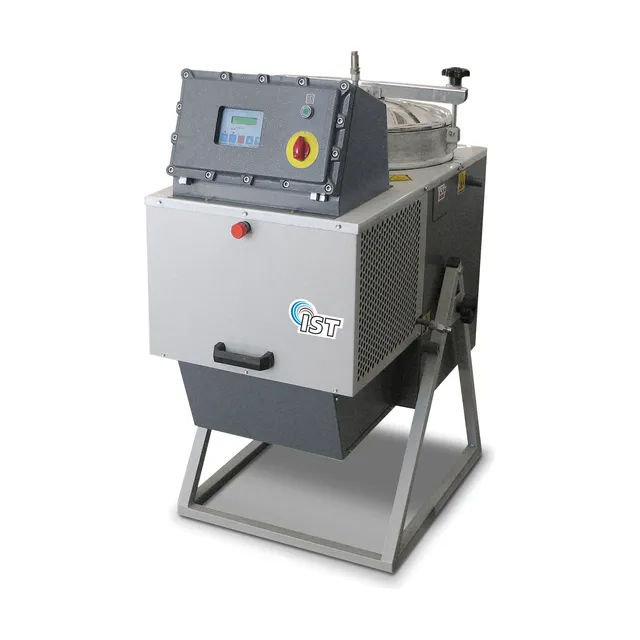
IST 32-62
Small industrial IST 32 and IST 62 solvent recovery units for regular solvent consumption – fill 30 or 62 l, 30–240 l/24 h.
30–240 l/24 hDistillation output
- Loading capacity
- 30 – 62 l
Frequently asked questions
How much solvent does IST ECO PLUS 202-400 recycle?
- ECO PLUS 202
- According to the manufacturer's technical data for IST ECO PLUS 202: throughput 200–1,000 l/24 h; filling volume 200 l.
- ECO PLUS 400
- According to the manufacturer's technical data for IST ECO PLUS 400: throughput 400–2,000 l/24 h; filling volume 400 l.
What is the installed power of IST ECO PLUS 202-400?
- ECO PLUS 202
- According to the manufacturer's technical data for IST ECO PLUS 202: installed power 12 kW.
- ECO PLUS 400
- According to the manufacturer's technical data for IST ECO PLUS 400: installed power 22 kW.
Have a different question? Write to us – a technician will answer. Send an enquiry
Technical terms are explained in the glossary.