
WALTHER PILOT
WALTHER PILOT WA600
Compact internally controlled WALTHER PILOT WA600 automatic spray gun for robots – precise quantity control, release agents, adhesives and paints.
Who it is for: robotic applications, release agents, low-viscosity adhesives and paints
- 8 barPressure
- 0.3mm - 2.2mmNozzle sizes
- 353 gWeight [net/gross]
Enquire about this productBring your paint – we will test it
The technician for your field will contact you as soon as possible. Prices are provided in our quotation.
Why WALTHER PILOT WA600
- Easy maintenanceThe two-part design is easy to dismantle.
- Several versionsMedium-pressure, high-pressure and circulation versions.
- Fine finishMaximum precision and a fine finish.
WA600 is designed for robots and a fine finish with release agents, low-viscosity solvent-based adhesives and paints. It consists of a material-carrying front section and a rear section (piston unit); it is available in medium-pressure, high-pressure and circulation versions.
Source of text: manufacturer’s page
Technical data
- Pressure
- 8 bar
- Sound level
- 83 dB(A)
- Materials
- Solvent-based, Water-based
- Nozzle sizes
- 0.3mm - 2.2mm
- Product dimensions [LxWxH]
- 120x54x82mm
- Weight [net/gross]
- 353 g
Data are taken from manufacturer documentation. We will verify them for your application before you order. Request a technical data sheet
How it works
How an air spray gun works
Material flows to the nozzle, which is closed by the needle. When the spray gun opens, air comes first, then the needle retracts and the material flows out. Atomising air from the annular gap of the air cap breaks it up into droplets and air from the horns shapes the pattern.
Automatic spray gun: instead of a trigger, it is opened by control air from the line or robot controller. The result is repeatable in series production.
Select a step or click a part of the diagram – we will show what it does, related terms, questions and products.
- Compressed air
- Paint / material
- Motion and recording
Description of all parts
- Material
Material flows into the spray gun from a cup or through a hose from a pressure tank or pump. In the material passage is a needle that closes the nozzle.
- Material supply
A cup on the spray gun (gravity, suction or pressure) or a hose connection from a pressure tank or pump. With automatic spray guns, the material can also circulate (supply and return connections).
WALTHER PILOT pressure and unpressurised tanks →
WAGNER spray pumps and packages →
- Material supply
- Air
Compressed air enters the spray gun. Its volume is set with the air regulator, the pattern width with the adjusting screw.
- Compressed air supply
Dry, clean air from the workshop supply. Automatic spray guns have separate connections for atomising air and shaping air.
WAGNER hoses and couplings → - Air and pattern control
The air volume is set by the air regulator, the pattern width continuously by the adjusting screw (closed = round pattern).
For example, the TOPFINISH GM 1030P changes the pattern width with a single knob and the air volume adjusts itself. For automatic spray guns, WAGNER distinguishes between air control in the gun (IC) and by external valves (EC).
- Compressed air supply
- Trigger
When the trigger is pulled slightly, the air valve opens – at first only air comes out.
- Trigger and air valve
Pulling the trigger slightly opens the air valve (pre-air); pulling further retracts the needle. The result depends on the sprayer – it is not exactly repeatable. - Control air
The line or robot control opens the spray gun with control air: first atomising and shaping air, then material. If the gun does not open, the cause may be low control air pressure.
- Trigger and air valve
- Needle and nozzle
Pulling further retracts the needle from the fluid nozzle and the material starts to flow. The material quantity is determined by the nozzle size and the material pressure, and fine-tuned with the needle stroke.
- Spray gun – needle and fluid nozzle: WA600
The gun body contains a spring-loaded fluid needle, an air valve and a fluid nozzle. The needle regulates the material flow; the nozzle determines its quantity.
Air spraying is divided into high-pressure (conventional), medium-pressure (HVLP+) and low-pressure (HVLP). Manual spray guns are used for one-off jobs, repairs and smaller areas; automatic spray guns for series production with repeatable results.
- Spray gun – needle and fluid nozzle: WA600
- Atomisation
Atomising air from the annular gap around the nozzle breaks the material up into droplets; air from the horns of the air cap shapes the pattern.
- Air cap
The central annular gap around the nozzle produces the atomising air; the holes in the horns produce the shaping air, which changes the round pattern into a flat one.
With HVLP, the gap between the air cap and the nozzle is larger – the air expands and has a low pressure at the outlet. The SupraCoat GA 3000SC is adapted to the material by changing the air cap.
- Air cap
Simplified principle of an air spray gun. Airless and AirCoat spray guns atomise using material pressure – their place in the system is shown in the airless and AirCoat pump diagram. We select the nozzle size, air cap and material supply according to the material.
Source: WALTHER PILOT – WaltherWiki (spraying methods, types of spray gun), PILOT III and GA 1020/1030 manuals; WAGNER – spray gun pages and brochures (walther-pilot.de, wagner-group.com).
Similar models – WALTHER PILOT spray guns
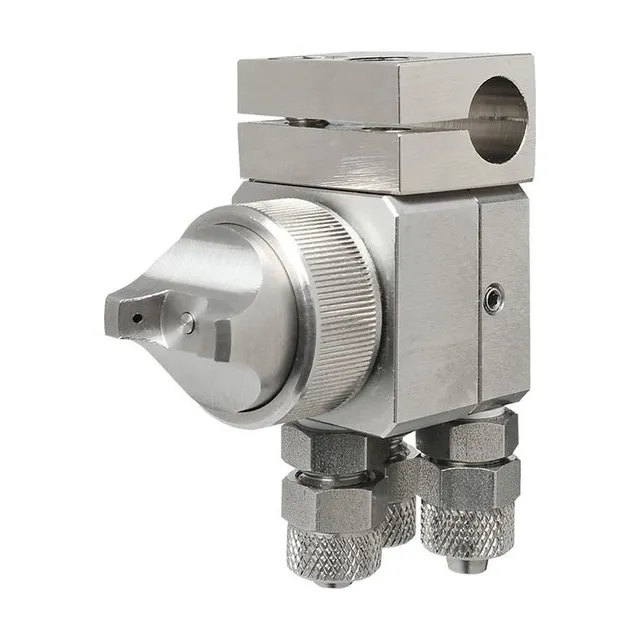
WALTHER PILOT
WA 110
The most compact WALTHER PILOT WA 110 automatic spray gun, externally controlled, with robot holder – release agents, oils and fragrances.
8 barPressure
- Weight [net/gross]
- 197.5 g
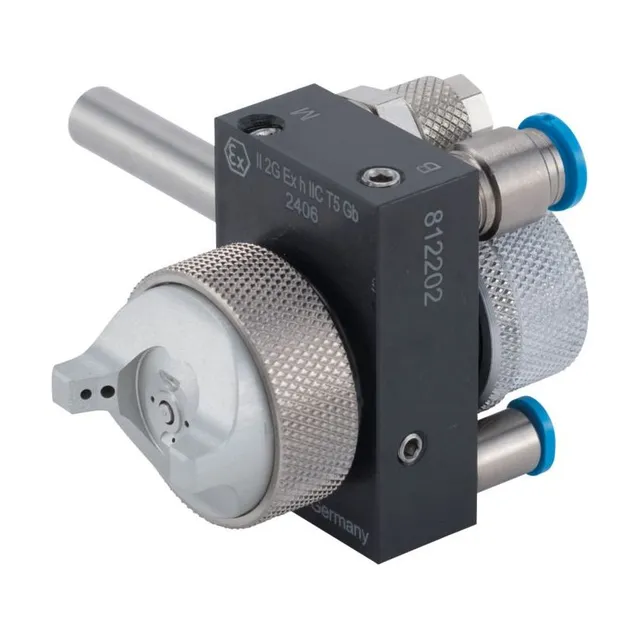
WALTHER PILOT
WA 100
Externally controlled WALTHER PILOT WA 100 automatic spray gun for release agents, low-viscosity solvent-based adhesives and paints.
8 barPressure
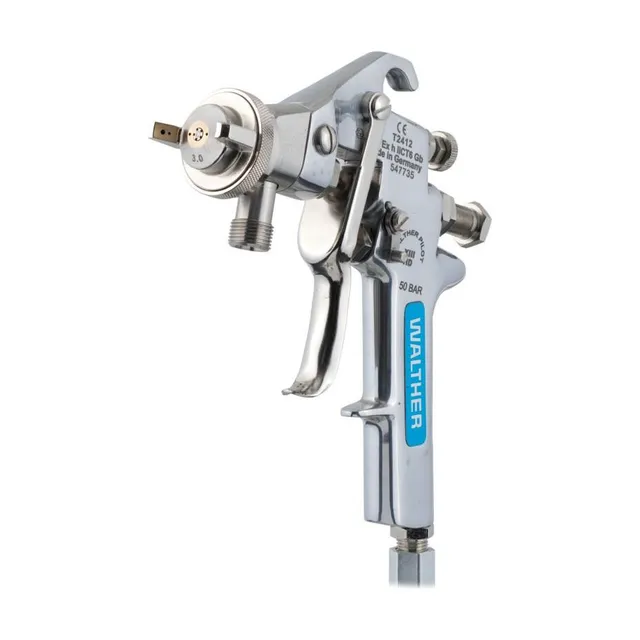
WALTHER PILOT
Pilot XIII FA
Robust WALTHER PILOT Pilot XIII FA manual spray gun for heavy-duty use – paints and aggressive media, with cup, feed, circulation or up to 50 bar.
8 barPressure
- Weight [net/gross]
- 715 g
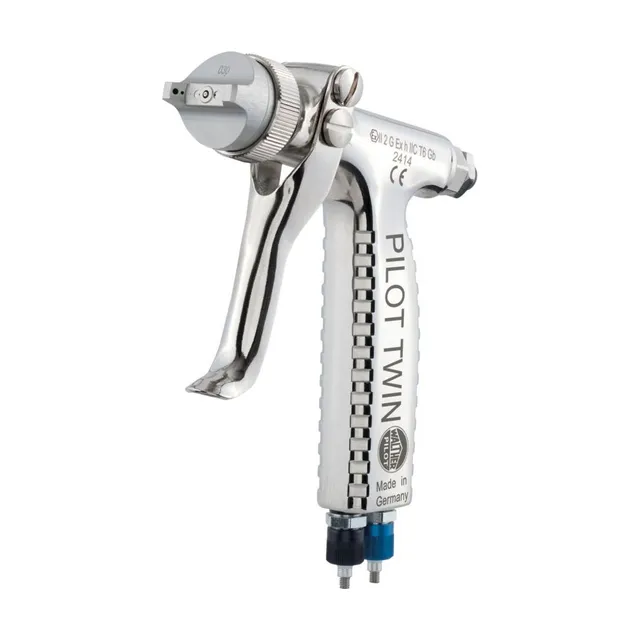
WALTHER PILOT
Pilot Twin
Compact WALTHER PILOT Pilot Twin spray gun for release agents and low-viscosity materials – HVLP, high transfer efficiency, lockable settings.
8 barPressure
- Weight [net]
- 227g
Frequently asked questions
What material pressure is WALTHER PILOT WA600 designed for?
Technical data according to the manufacturer for WALTHER PILOT WA600 – material pressure 8 bar.
Which nozzles and materials are used with WALTHER PILOT WA600?
Technical data according to the manufacturer for WALTHER PILOT WA600 – nozzle sizes 0.3–2.2 mm; processable materials: solvent-based, water-based.
How much does WALTHER PILOT WA600 weigh and what is it made of?
Weight 353 g; dimensions 120 × 54 × 82 mm; noise level 83 dB(A).
Have a different question? Write to us – a technician will answer. Send an enquiry
Technical terms are explained in the glossary.