Article
The most common spraying defects and how to prevent them
Published
Runs, tails at the edges of the spray jet, mist or a pulsating spray jet usually have a simple cause – pressure, distance, viscosity or a worn nozzle. An overview of practical advice from WAGNER and WALTHER PILOT manuals, with a defect – cause – remedy table.

Start with a test, not a part
Most defects are revealed by a test spray on a piece of cardboard or a test panel before the first part. The spray pattern immediately shows whether the edges are sharp, the centre is thin or the spray jet is pulsating – and the settings can be corrected without damaging the product.
Surface preparation is equally important. According to WAGNER, a clean and smooth substrate helps to distribute the material evenly and thus limits runs, orange peel and areas that are too thin. Dust, grease and loose dirt, on the other hand, impair adhesion.
Pressure: start low and increase
The right pressure is the lowest pressure at which the material is still well atomised. The operating manual of WAGNER Airless units recommends increasing the pressure slowly, watching the spray jet and stopping when atomisation is good. Higher pressure than necessary does not produce a better surface, only more wear and more mist.
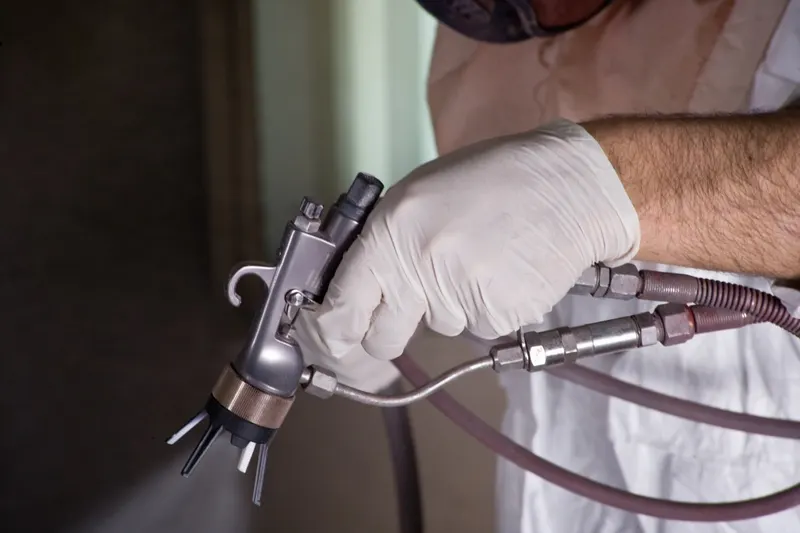
If the spray jet in airless spraying has sharp edges or stripes (‘tails’), WAGNER advises first increasing the pressure, then considering thinning and checking the nozzle. A worn or unsuitable nozzle produces a poor spray jet even at the right pressure – in that case only replacing it will help.
With air spray guns, the atomising air is also adjusted. According to the WALTHER PILOT manual, large droplets in the spray jet mean that the air pressure must be increased, and a spray jet centre that is too thin means that it must be reduced. Heavy ends of the spray jet are corrected by setting a rounder spray pattern on the air cap.
Distance, angle, speed and overlap
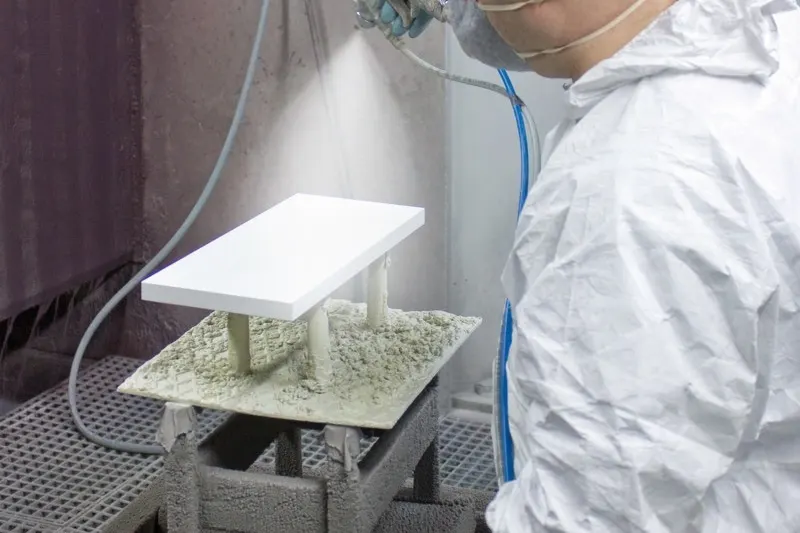
Always hold the gun perpendicular to the part and at the same distance. If you tilt it, one edge of the strip will be thicker than the other. That is why the movement is made with the whole arm, not just the wrist.
- The distance is determined by the technology and the gun manual – for Airless, WAGNER states approximately 25 – 30 cm in its manual; for other technologies the gun manual applies, generally around 25 – 30 cm.
- Too close: too much material reaches the part and runs form.
- Too far or with a swinging motion: the spray jet widens, the layer becomes thinner and overspray increases.
- Keep the speed of movement constant, horizontally or vertically. According to WAGNER, runs do not form at the correct speed.
- Pull the trigger only when your hand is moving and release it before it stops. Start outside the part.
- Overlap adjacent strips by approximately 30 % so that the layer is even and free of stripes.
For excessive mist, WAGNER recommends adjusting the air-to-material ratio and reducing the distance from the part. Every reduction in overspray means less paint in the booth filter.
Material viscosity and filtration
Material that is too thick is a common cause of a poor spray jet and pulsation. Viscosity is adjusted by thinning according to the paint manufacturer’s instructions.
The filter should be as fine as the material and nozzle allow – materials with coarser pigment or filler and larger nozzles need a coarser filter. A clogged high-pressure filter or gun filter causes a poor spray jet, a clogged nozzle and pump failures. The atomising air must be dry and clean – according to WAGNER, dirt and moisture impair spraying quality; a water separator helps against condensate.
Defect, cause and what to do
| Defect | Possible cause | What to do |
|---|---|---|
| Sharp spray jet edges, stripes (‘tails’) | low pressure, thick material, worn or unsuitable nozzle | increase pressure, thin according to the paint manufacturer, replace the nozzle |
| Runs | gun too close, slow or uneven movement | keep the distance, move at a constant speed |
| A lot of mist and overspray | distance too great, swinging the gun, unsuitable air-to-material ratio | move the gun closer, hold it perpendicular, adjust air and material |
| One edge of the strip thicker | gun not perpendicular to the part | hold the gun perpendicular, move the whole arm |
| One-sided spray jet (air spray gun) | dirty air cap | remove and clean the air cap |
| Large droplets in the spray jet (air spray gun) | too little atomising air | increase the atomising air pressure |
| Thin spray jet centre (air spray gun) | too much atomising air | reduce the atomising air pressure |
| Orange peel | too little atomising air, material too thick, unsuitable nozzle | increase the atomising air, thin according to the paint manufacturer, change the nozzle if necessary |
| Pulsating spray jet | thick material, low pressure, clogged valves or filters, worn valves and seals | thin, increase pressure or use a smaller nozzle, clean, replace worn parts |
| Gun drips | dirty or damaged needle or nozzle | clean or replace |
| Pump runs while the gun is closed | worn seals, valves or piston | replace parts – service |
Cleaning and flushing after work
The equipment is cleaned after every job and at every change of material. During flushing, the pump and hoses are flushed until clean liquid flows from the return hose and then from the gun (without the nozzle). Two-component materials must be flushed out before the end of the pot life; heat shortens it.
- The cleaning agent must be suitable for the sprayed material; non-flammable agents are preferred.
- Do not immerse the gun in solvent and do not clean it with hard or sharp objects.
- With WALTHER PILOT guns, do not use halogenated hydrocarbons, acids, regenerated thinners or paint strippers – they damage plated parts.
- After cleaning, do not run the pump dry – it must remain filled with flushing agent or material.
Maintenance and wear checks
Wear shows on the surface before it shows on the machine. The nozzle gradually wears out and the spray jet deteriorates; worn pump seals and valves cause pulsation or the pump running while the gun is closed. Clean the air cap and nozzle of WALTHER PILOT guns with a soft brush and lubricate moving parts at least once a week.
Check high-pressure hoses and couplings every day. According to WAGNER, even an undamaged hose is replaced 6 years after the fitting was crimped or 10 years after the date printed on the hose. Depressurise the equipment before every nozzle change or work on the gun.
When neither adjustment nor cleaning helps
If neither pressure, thinning nor cleaning improves the spray jet, the cause is usually a worn nozzle or the pump. You will find replacement nozzles in the WAGNER nozzles category; our service will check and repair the pump, valves and seals for you.
Is this an issue in your plant?
Tell us what you need – the technician for your area will get back to you.
Your technician
Peter Kovár
WAGNER Sales Manager | SK & CZ
- Phone – Peter Kovár: +421 911 804 818
- E-mail – Peter Kovár: kovar@
technikum.sk - Speaks: Slovak, Czech
Do you have a question on this topic?The AI adviser answers immediately
Your technician
Peter Kovár
WAGNER Sales Manager | SK & CZ
- Phone – Peter Kovár: +421 911 804 818
- E-mail – Peter Kovár: kovar@
technikum.sk - Speaks: Slovak, Czech
Frequently asked questions
How can a setting error be detected before the first part?
Most defects are revealed by a test spray on a piece of cardboard or a test panel before the first part. The spray pattern immediately shows whether the edges are sharp, the centre is thin or the spray jet is pulsating – and the settings can be corrected without damaging the product.
What pressure should be set for spraying?
The right pressure is the lowest pressure at which the material is still well atomised. The operating manual of WAGNER Airless units recommends increasing the pressure slowly, watching the spray jet and stopping when atomisation is good. Higher pressure than necessary does not produce a better surface, only more wear and more mist.
How does a worn nozzle or pump show itself?
Wear shows on the surface before it shows on the machine. The nozzle gradually wears out and the spray jet deteriorates; worn pump seals and valves cause pulsation or the pump running while the gun is closed. Clean the air cap and nozzle of WALTHER PILOT guns with a soft brush and lubricate moving parts at least once a week.
Have a different question? Write to us – a technician will answer. Send an enquiry
Technical terms are explained in the glossary.