Article
Spray equipment maintenance: what to check daily, weekly and once a year
Published
The pump, hoses, filters and guns need a short daily check, flushing after work and a few tasks once a week or once a year. A checklist for the paint shop compiled from the public WAGNER and WALTHER PILOT manuals, with an interval – what – why table.

Why regular maintenance pays off
Clean and inspected equipment sprays better and lasts longer. According to the WAGNER manuals, regular flushing, cleaning and maintenance ensure that the pump maintains its performance and draws in material well. Dried material, clogged filters and worn hoses are also a frequent cause of the problems described in the article The most common spraying defects.
This list summarises the tasks that recur in the WAGNER and WALTHER PILOT manuals. It applies to pump-based equipment (Airless and AirCoat); for air spray guns and pressure tanks (Airspray), the WALTHER PILOT manual applies – guns are covered separately below. The exact procedure, order of steps and settings are always in the manual for the specific equipment – and that manual takes precedence.
Before any intervention: release the pressure
While there is pressure in the system, there is a risk of paint or flushing fluid being injected into the skin and of a hose bursting. The WAGNER manuals therefore require the pressure to be released whenever:
- after spraying is finished,
- before cleaning, maintenance or repair,
- before checking anything on the equipment and before moving it,
- before removing the nozzle or filter from the gun.
In addition to releasing the pressure in the pump, hose and gun, the gun must be secured against the trigger being pulled, the compressed air supply must be shut off and the control unit disconnected from the mains. The pressure is released via the return valve or by opening the gun, as described in the manual.
Daily: before work and during the shift
- Hoses, pipes and couplings – check and replace if damaged. Check the tightness of connections before every start-up.
- Earthing – check (manuals for Cobra and ZIP double-diaphragm pumps).
- Filters – check and clean the high-pressure filter daily or as required; with ZIP pumps also the suction and outlet filters.
- Separating fluid (in the cup between the air motor and the fluid section, protects the seals) – on a piston pump, check the level in the cup daily and top up. Without it, the seals run dry, wear quickly and paint or solvent may leak.
- Condensate – drain frequently from the filter with air regulator on AirCoat units so that the water does not reach the maximum mark.
According to WAGNER, leaks and damage are also checked by sight and smell – for example daily before starting, at the end of work or once a week. In the event of a fault, the equipment must be stopped immediately and repaired.
After work: flushing and cleaning
When work is finished, no residual material may be allowed to dry in the equipment. The procedure according to the WAGNER manuals in brief:
- release the pressure and flush the system via the return valve and then through the gun without the nozzle into an earthed container until clean flushing fluid comes out,
- the flushing agent must be compatible with the material; non-flammable agents are preferred and containers must be electrically conductive,
- clean and check the suction system and suction filter, clean the outside of the equipment,
- do not clean the bowl of the filter with air regulator with solvent – it becomes brittle and may crack,
- leave the pump filled with flushing fluid; after cleaning, do not run it empty, because an explosive mixture can form in a partially empty pump.
With 2K materials, flushing must be done before the end of the pot life – heat shortens it, and cured material can destroy both the pump and the lines. According to WAGNER, the hardener pump is not flushed with water, only with a suitable solvent.
Guns and nozzles
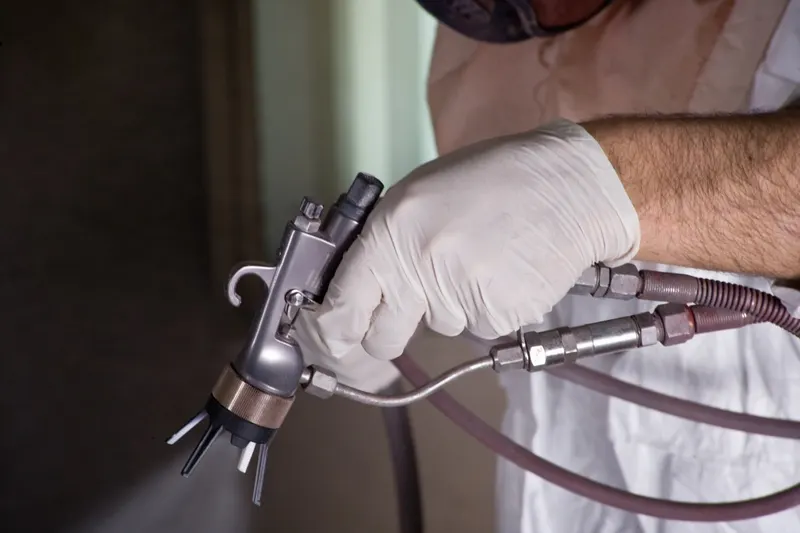
According to WAGNER, an airless gun is cleaned after every use. The nozzle should be soaked in a suitable cleaning agent, residues removed with a wooden toothpick and the orifice checked with a magnifying glass – a metal object can easily damage the carbide insert. How to choose a new nozzle when the old one is worn is explained in the article Choosing a nozzle for Airless and AirCoat.
According to the manual, a WALTHER PILOT air spray gun must be cleaned before every change of material and at least once a week. The gun is never immersed in solvent, the air cap and fluid nozzle are cleaned with a soft brush, and moving parts are lightly lubricated at least once a week.
Weekly, monthly and once a year
Longer intervals are given mainly in the manuals for diaphragm pumps. Every week, the equipment is checked for damage and the function of the safety devices, and with ZIP pumps also the fastening screws and air and fluid leaks. On the Cobra high-pressure diaphragm pump, which has an oil-filled hydraulic section, the oil level is checked monthly and the oil is changed after 500 operating hours or once a year. Pneumatic piston and diaphragm pumps (e.g. Puma, ZIP) have no oil filling.
The WAGNER manuals recommend having the safe condition of the equipment checked by a specialist, for example a service technician, at least once every 12 months (according to the German regulation DGUV 100-500); equipment that has been taken out of service only needs to be checked before it is next started up. In Slovakia, the scope and intervals of regular inspections are determined by the employer (Slovak Government Regulation No. 392/2006 Coll.) – the annual interval from the manual is a good basis for this. In the Czech Republic, follow-up inspections of machinery and equipment are carried out at least once every 12 months (Government Regulation No. 378/2001 Coll.). Keep a record of each inspection.
Hoses age even when handled correctly. The operator should define inspection intervals for them and keep records. According to the WAGNER manuals (e.g. Wildcat/Puma, Cobra, ZIP), the entire hose must be replaced 6 years after crimping (date on the fitting) or 10 years after the printed date – whichever comes first – even if it is not damaged. The exact data are in the manual for the specific equipment. The hose must not be kinked, run over by a trolley or used to pull the equipment. Suitable hoses can be found in the WAGNER hoses category.
Shutdown and storage
For a break, it is sufficient to release the material pressure; for a longer interruption, also the air pressure in the pneumatic motor. For longer shutdowns, the WAGNER manuals prescribe thorough cleaning and corrosion protection:
- carry out the full shutdown with flushing and cleaning,
- replace the water or solvent in the pump with a suitable preservative,
- empty the pump in a controlled manner and seal the openings,
- on a piston pump, fill the cup with separating fluid and store it upright,
- store in a dry, enclosed room free from dust and vibration.
| Interval | What | Why |
|---|---|---|
| before any intervention | release the pressure, secure the gun, disconnect air and mains | protection against material injection and hose bursting |
| before start-up | tightness of connections | material leaks and vapours |
| daily | hoses, pipes, couplings; earthing | safety, hose bursting, static electricity |
| daily or as required | high-pressure, suction and outlet filters | a clogged filter impairs the spray pattern and clogs the nozzle |
| daily | piston pump separating fluid | seals must not run dry |
| frequently | condensate in the air filter (AirCoat) | water must not exceed the maximum mark |
| after work | flushing, cleaning the suction filter, gun and nozzle | dried material reduces pump performance |
| 2K material | flushing before the end of the pot life | cured material will destroy the pump |
| weekly | damage, safety devices, screws, leaks; cleaning and lubricating the WALTHER PILOT gun | safe and reliable operation |
| monthly / annually | oil in the hydraulic section of the Cobra pump; change after 500 h or once a year | according to the Cobra manual |
| at least once every 12 months | inspection by a specialist | safe condition of the equipment |
| after 6 / 10 years | replacement of the entire hose | a hose ages even when used correctly |
Carry out other tasks for which the manual gives no interval regularly in accordance with the manual for the specific equipment. According to WAGNER, repairs and replacement of parts may only be carried out by WAGNER service or a trained person, using original parts.
Introduce a maintenance plan
Set up a simple checklist based on the table and add the intervals from the manual for each piece of equipment. Regular maintenance, the annual inspection and repairs are carried out by our service – service within 48 hours means a service call-out within 48 hours, or a repair within 48 hours if the machine is with us and the parts are available. We supply filters, nozzles, seals and hoses as spare parts, and if you are considering a new pump, the article How to choose a spray pump will help.
Do you need service?
Send an enquiry with photos and a video of the fault, or call the technician directly.
Your technician
Peter Kovár
WAGNER Sales Manager | SK & CZ
- Phone – Peter Kovár: +421 911 804 818
- E-mail – Peter Kovár: kovar@
technikum.sk - Speaks: Slovak, Czech
Do you have a question on this topic?The AI adviser answers immediately
Your technician
Peter Kovár
WAGNER Sales Manager | SK & CZ
- Phone – Peter Kovár: +421 911 804 818
- E-mail – Peter Kovár: kovar@
technikum.sk - Speaks: Slovak, Czech
Frequently asked questions
Why does regular maintenance of spray equipment pay off?
Clean and inspected equipment sprays better and lasts longer. According to the WAGNER manuals, regular flushing, cleaning and maintenance ensure that the pump maintains its performance and draws in material well. Dried material, clogged filters and worn hoses are also a frequent cause of the problems described in the article The most common spraying defects.
How are an airless gun and nozzle cleaned?
According to WAGNER, an airless gun is cleaned after every use. The nozzle should be soaked in a suitable cleaning agent, residues removed with a wooden toothpick and the orifice checked with a magnifying glass – a metal object can easily damage the carbide insert. How to choose a new nozzle when the old one is worn is explained in the article Choosing a nozzle for Airless and AirCoat.
Have a different question? Write to us – a technician will answer. Send an enquiry
Technical terms are explained in the glossary.