Article
Airspray, HVLP, Airless or AirCoat: how the spraying methods differ
Published
Four names you will find on every spray gun and pump. They differ in what atomises the paint – air, pressure or both – and this determines the surface quality, output and the amount of paint that ends up off the part.

Airspray: air atomises the paint
In air spraying, the paint is atomised by compressed air coming out of the gun head. The result is a very fine surface, but also more overspray – paint that does not land on the part and ends up in the air or in the filter.
Air spraying is divided into three types according to the atomising air pressure:
- high-pressure (conventional) spraying
- HVLP+ – medium pressure, atomising air approximately 1 – 1.5 bar; between conventional spraying and HVLP, with better surface quality than HVLP
- HVLP – low pressure (High Volume, Low Pressure), atomising air up to 0.7 bar in high volume; less overspray and higher transfer efficiency
Airless: pressure atomises the paint
In airless spraying, a pump pressurises the paint to a high pressure and forces it through the small orifice of the tip. The paint is atomised without air. This gives high output and thicker coats, which is why Airless is used, for example, on large surfaces and for corrosion protection.
AirCoat: pressure and a little air
AirCoat is Airless with assisting air: the piston pump operates from approximately 20 bar and a small amount of air at the tip makes the atomisation finer. It is a compromise between the quality of air spraying and the output of Airless. AirCoat is the WAGNER name; other manufacturers use the name Airmix.
Comparison in one table
| Method | What atomises the paint | Pressure | Surface and coat | Overspray | Output |
|---|---|---|---|---|---|
| Conventional Airspray | compressed air from the gun head | high-pressure atomising air | very fine surface | more overspray | – |
| HVLP+ | compressed air | air approximately 1 – 1.5 bar | better surface than HVLP | – | – |
| HVLP | high volume of air | air up to 0.7 bar | – | less overspray, higher transfer efficiency | – |
| Airless | paint pressure, no air | high paint pressure | thicker coats | – | high output |
| AirCoat / Airmix | paint pressure and a little air at the tip | piston pump from approximately 20 bar | compromise between Airspray and Airless | – | compromise between Airspray and Airless |
Electrostatic application: an add-on to the spraying method
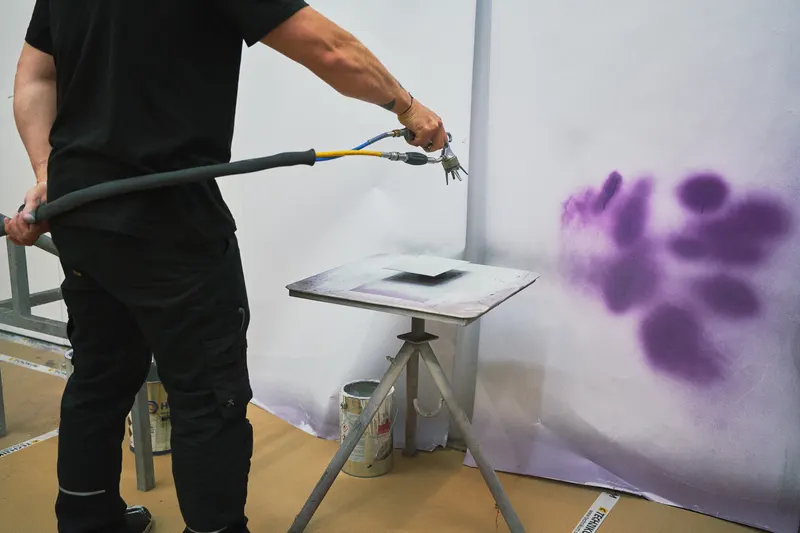
In electrostatic application, the paint particles are electrically charged and attracted to the earthed part. The paint also wraps around to the back of the part, so there is less overspray and higher transfer efficiency. Reliable earthing of the part is a prerequisite.
How to choose
A spray gun is chosen according to the application method, manual or automatic operation, and the material. Each model in the catalogue states what it is intended for – see WAGNER spray guns and pumps. If you are not sure, tell us what you coat and in what quantities, and we will propose a set-up for your paint shop.
Is this an issue in your plant?
Tell us what you need – the technician for your area will get back to you.
Your technician
Peter Kovár
WAGNER Sales Manager | SK & CZ
- Phone – Peter Kovár: +421 911 804 818
- E-mail – Peter Kovár: kovar@
technikum.sk - Speaks: Slovak, Czech
Do you have a question on this topic?The AI adviser answers immediately
Your technician
Peter Kovár
WAGNER Sales Manager | SK & CZ
- Phone – Peter Kovár: +421 911 804 818
- E-mail – Peter Kovár: kovar@
technikum.sk - Speaks: Slovak, Czech