Article
Electrostatic spraying of liquid paints: how it works and what it needs
Published
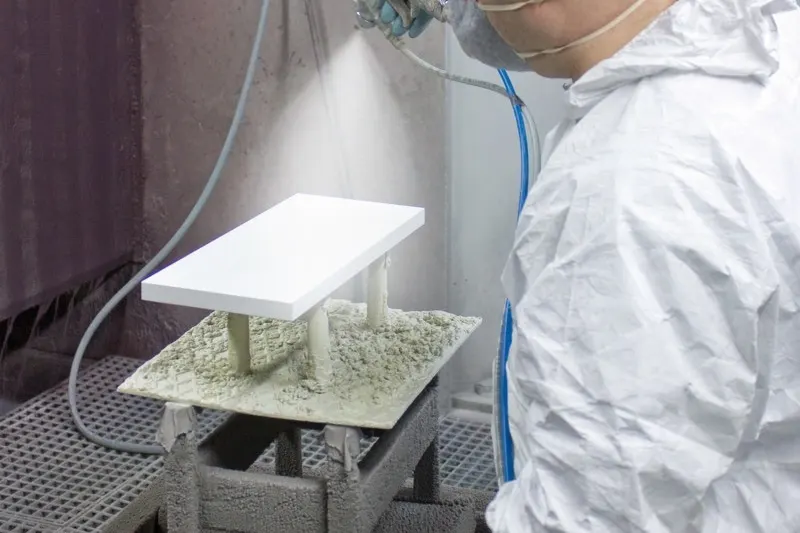
In electrostatic spraying, the charged paint is attracted to the earthed part and also wraps around to its back, so more paint stays on the part and less of it ends up in the filter. For this to work, the paint, the part, the earthing and the pressure settings must all be right.

How electrostatic spraying works
In electrostatic spraying, the droplets of atomised paint receive a negative electrical charge and the part is earthed, so the paint is attracted to the part. The high voltage is generated by a high-voltage cascade built into the gun. The gun therefore does three things at once: it atomises the paint, creates an electric field and charges the droplets.
The charged droplets travel along the field lines, which always meet the part perpendicularly – even on the side facing away from the gun. The paint thus flows around the part and also adheres to its rear side. This phenomenon is called the wrap-around effect.
- A high-voltage cascade in the gun charges the paint droplets negatively (−).
- An electric field forms between the gun and the part – the droplets travel along the field lines.
- The field lines flow around the part, so paint also reaches the sides and the back (wrap-around effect).
- The part must be reliably earthed – otherwise the charge has nowhere to go.
Why there is less overspray and higher efficiency
A larger share of the paint ends up on the part rather than in the extraction, so there is less overspray and higher transfer efficiency. According to WAGNER, GM 5000 electrostatic guns usually save 30 – 50 % of material compared with conventional spraying without electrostatics. The actual saving depends on the paint, the shape of the part and the settings.
- wrap-around effect – paint also reaches the rear side; the greatest savings are on grid-like and rounded parts
- finer atomisation – droplets with the same charge repel each other, and material and air pressure can often be reduced
- uniform layer – the droplets land perpendicularly and evenly distributed, giving a higher-quality surface
- edges and corners – the field lines concentrate there, so the layer is not missing
- less paint mist, less contamination and cleaning
An example from practice: according to a WAGNER reference, the silo manufacturer AWILA switched from Airless spraying to electrostatic application with a GM 5000 manual gun. On large parts it achieves a more uniform layer thickness, and on small and complex parts it reports material savings of 30 – 50 %.
What has to be in place
- Conductive paint. Waterborne paints are conductive; solvent-based paints must have at least a minimum conductivity to be chargeable. Check suitability with the paint manufacturer or by a spray trial.
- Conductive part. Metal is the most suitable; the electrical resistance of the part should not exceed 1 MΩ. Wood can be sprayed at a residual moisture content of at least 15 %. Plastic and glass need pre-treatment, for example a conductive primer.
- Reliable earthing. Earth structures, hangers, parts and equipment to one common point. If the charge has nowhere to go, the paint is not attracted to the part and ends up in the surroundings – including on the painter.
- Clean contacts. Paint deposits on hangers, clamps and earthing cables interrupt the earth connection and the electrostatic effect is lost.
- Appropriate pressure. Electrostatic application is not used at material pressures above 250 bar – large, fast droplets have so much kinetic energy that they override the electrostatic effect. The lower the material and air pressure, the better the effect.
Solvent-based or waterborne paints?
The type of paint determines how the paint is charged, and therefore the entire set-up. Solvent-based paint has a high electrical resistance, so it is charged by an electrode directly in the gun in the centre of the spray pattern, and the voltage is dissipated within the gun. If the paint is too conductive, the voltage drops and can arc out through the hose – special insulated hoses are available for such paint.
Waterborne paint is conductive, so with internal charging the whole system is under high voltage – the gun, hose, pump and container. Everything must be insulated: in a closed room, behind a grille or in an insulated cabinet, for example WAGNER AquaCoat. The paint container can only be accessed once the system has been fully discharged.
| Paint and method | Where the paint is charged | What is live | Note |
|---|---|---|---|
| solvent-based | electrode in the gun in the centre of the spray pattern | the voltage is dissipated within the gun | insulated hose for paint that is too conductive |
| waterborne – internal charging | in the gun or in the paint container | the whole system: gun, hose, pump, container | insulation by a room, grille or cabinet (AquaCoat) |
| waterborne – external charging (corona) | electrodes outside the spray pattern ionise the surrounding air | the atomiser is insulated, the system is not | mainly rotary atomisers, e.g. WAGNER TOPFINISH RobotBell 1 / Bell 1S ECH; slightly lower savings, but there is no need to insulate the whole system including the paint mixing room, so the investment is lower |
Faraday cage, cavities and edges
The field lines cannot reach into cavities, inner surfaces and cup-shaped forms – the field there is shielded by the Faraday effect (the Faraday cage principle). For these areas, the electrostatics must be switched off briefly or spraying must be done with higher material and air pressure.
At edges and corners it is the opposite: the field lines concentrate there, the edges are reliably covered, but the layer can be too thick (picture-frame effect). In such areas, WAGNER recommends reducing the high voltage.
Airspray, AirCoat or rotary atomiser
Electrostatics is used with air spraying (Airspray), with AirCoat and with rotary atomisers. Airspray and the rotary atomiser produce the smallest droplets and the highest surface quality. AirCoat is faster, has larger droplets and slightly more overspray, but thanks to electrostatics still gives a very good surface. Separate versions are available for solvent-based and waterborne paints.
The choice between a manual and an automatic gun depends mainly on economics and on whether the part can be automated. The manual gun remains where lifting equipment, linear axes or a robot are not worthwhile or cannot be used, for example for very long crane parts. Automatic guns are mounted on traversing rails, in conveyor lines or on robot arms. In robotic spraying, especially in the automotive industry, high-speed rotary electrostatic atomisers – bells – are used.
Safety and ATEX
An electrostatic gun works with high voltage in an environment containing vapours, so it must comply with ATEX rules. According to the manufacturer, WAGNER GM 5000 manual guns are designed for ATEX zone 1 and their output voltage is a maximum of 80 kV, or 70 kV in the version for waterborne paints. The control unit monitors the gun’s earthing and switches off the high voltage automatically if it is interrupted. According to WAGNER, the VM 500 and VM 5000 control units may be placed in zone 2, i.e. closer to the gun. The VM 5000W unit for waterborne paints is not designed for zone 2. Zones and rules are explained in the article ATEX in the paint shop.
With waterborne paints, the painter is protected by an insulated cabinet: according to WAGNER, with the AquaCoat system access to the interior is mechanically locked during spraying and the most important safety features are duplicated.
Practical tips
- Increase the material and air pressure gradually until atomisation is good. Excessive pressure gives the droplets so much speed that the field cannot capture them.
- Clean paint off hangers, clamps and earthing points regularly.
- When the control unit reports deteriorating conditions, check the earthing of the parts, the distance to the part and the resistance of the paint.
- Reduce the voltage on edges and switch it off briefly for cavities.
- For a non-conductive part, a conductive primer helps, or start spraying near the earthing point – the wet conductive layer then creates a connection to earth.
- Before deciding, test your own paint on your own part.
Try electrostatic application on your own part
If you are considering switching to electrostatic application, bring your parts and paint for a spray trial at the Industrial Coating Centre (showroom and test centre in Trnava). In its paint shop, low-pressure, high-pressure and electrostatic spraying can be compared side by side – you will see whether the paint can be charged, how it wraps around the part and which settings suit it.
Is this an issue in your plant?
Tell us what you need – the technician for your area will get back to you.
Your technician
Peter Kovár
WAGNER Sales Manager | SK & CZ
- Phone – Peter Kovár: +421 911 804 818
- E-mail – Peter Kovár: kovar@
technikum.sk - Speaks: Slovak, Czech
Do you have a question on this topic?The AI adviser answers immediately
Your technician
Peter Kovár
WAGNER Sales Manager | SK & CZ
- Phone – Peter Kovár: +421 911 804 818
- E-mail – Peter Kovár: kovar@
technikum.sk - Speaks: Slovak, Czech
Frequently asked questions
How does electrostatic paint spraying work?
In electrostatic spraying, the droplets of atomised paint receive a negative electrical charge and the part is earthed, so the paint is attracted to the part. The high voltage is generated by a high-voltage cascade built into the gun. The gun therefore does three things at once: it atomises the paint, creates an electric field and charges the droplets.
Why is there less overspray with electrostatic application?
A larger share of the paint ends up on the part rather than in the extraction, so there is less overspray and higher transfer efficiency. According to WAGNER, GM 5000 electrostatic guns usually save 30 – 50 % of material compared with conventional spraying without electrostatics. The actual saving depends on the paint, the shape of the part and the settings.
Why are cavities and internal surfaces difficult to coat electrostatically?
The field lines cannot reach into cavities, inner surfaces and cup-shaped forms – the field there is shielded by the Faraday effect (the Faraday cage principle). For these areas, the electrostatics must be switched off briefly or spraying must be done with higher material and air pressure.
Have a different question? Write to us – a technician will answer. Send an enquiry
Technical terms are explained in the glossary.