
WAGNER

WAGNER pressure tanks
Material tanks for low-pressure spraying. LDG and MDG series with the manufacturer's technical data.
About WAGNER – Certified Partner for the Czech Republic and Slovakia
Models (2)
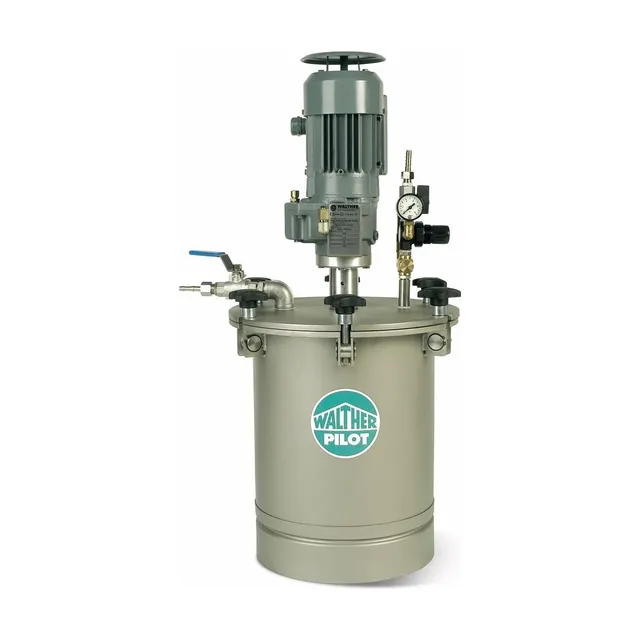
LDG pressure tanks
Lightweight WAGNER LDG stainless steel material pressure tanks (5, 10, 20) for pulsation-free preparation and supply of material – up to 6 bar.
6 barPressure
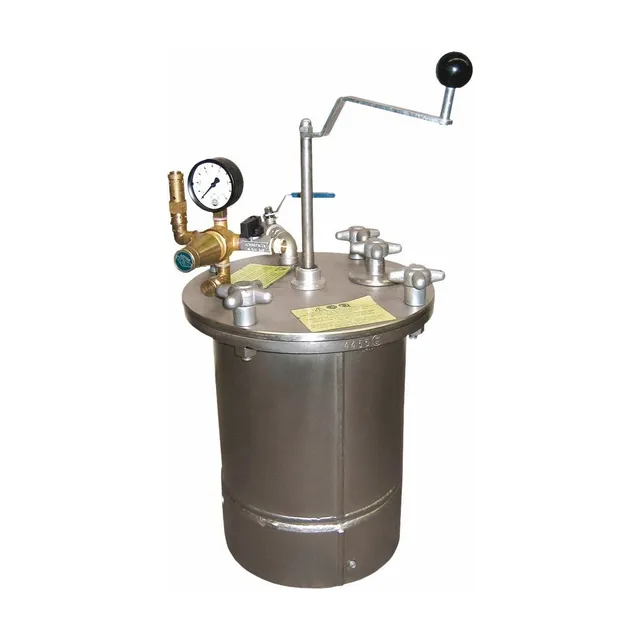
MDG pressure tanks
WAGNER MDG stainless steel material pressure tanks (2 – 60) for pulsation-free preparation, degassing, temperature control and supply of material.
- Pressure
- depending on version
Also searched as: pressure tank, pressure tanks, tanks
How it works
How spraying from a pressure tank works
In a closed tank, compressed air presses on the material and forces it through a hose to the spray gun – evenly and without pulsation, without an electrically driven pump. The spray gun also receives atomising air separately.
Select a step or click a part of the diagram – we will show what it does, related terms, questions and products.
- Compressed air
- Paint / material
Description of all parts
- Air
Compressed air from the supply goes to the tank regulator and separately to the spray gun as atomising air.
- Compressed air supply
Compressed air from the workshop supply. - Atomising air
Air for the spray gun is supplied separately from the material, through an air hose.
- Compressed air supply
- Pressure regulation
The regulator with pressure gauge sets the pressure in the tank – and thus the amount of material flowing to the spray gun.
- Tank pressure regulator
Sets the pressure in the tank. Depending on the version, tanks have one or more regulators, including a precision regulator.
- Tank pressure regulator
- Pressure tank
The air presses on the material in the closed tank and forces it out at constant pressure. The material can be mixed with an agitator; the tank may only be filled after the pressure has been released.
- Pressure tank
Closed tank in which air presses on the material. Delivery is pulsation-free; the agitator can be manual, pneumatic or electric. Without an additional pump, the material cannot be circulated.
Advantages: constant pressure and gentle handling of sensitive materials (adhesives, UV, reactive). Limitations: lower material pressure, less suitable for high viscosity, and refilling is only possible after releasing the pressure. A pump is better for high pressure, frequent colour changes and circulation.
- Pressure tank
- Hose
The material hose carries the material from the top or bottom outlet of the tank to the spray gun.
- Material hose
Carries the material from the tank to the spray gun.
- Material hose
- Spray gun
The spray gun atomises the material with atomising air from the air cap.
- Spray gun
Air spray gun: air from the slot of the air cap atomises the material, and the side holes adjust the spray pattern.
Material flow depends on the nozzle diameter and the tank pressure; it is fine-tuned with the needle stroke adjustment screw.
WAGNER spray guns and atomisers →
WALTHER PILOT spray guns →
- Spray gun
Simplified principle. Unpressurised tanks (e.g. FMB) are used to prepare and supply material for a pump – they do not work this way. We will select the number of regulators and the tank outlet according to the application.
Source: WALTHER PILOT – WaltherWiki, pressure tanks and spraying methods; data sheets for MDG and LDG tanks (walther-pilot.de, wagner-group.com).
Video
Presented by Peter Kovár, WAGNER Sales Manager for the Czech Republic and Slovakia. The video is in Slovak.
Pressure tanks and pressure regulatorsPressure tanks with agitators and material pressure regulators.