
WAGNER

LDG pressure tanks WAGNER
Manufacturer designation: Material pressure tanks LDG
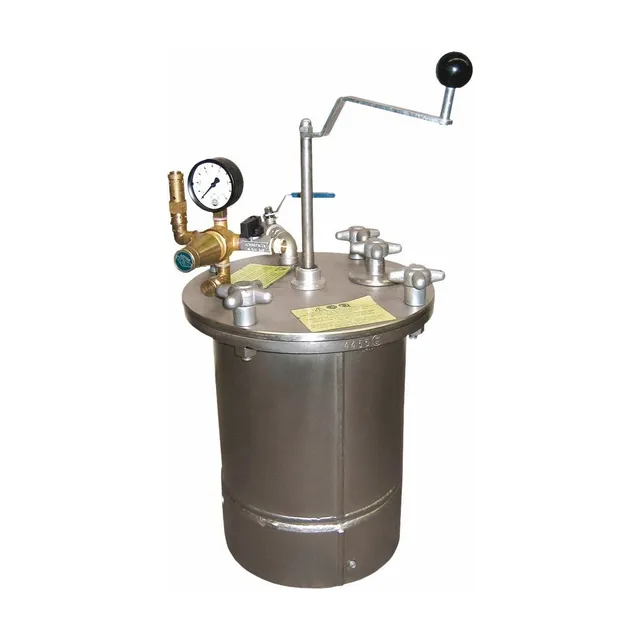
Lightweight WAGNER LDG stainless steel material pressure tanks (5, 10, 20) for pulsation-free preparation and supply of material – up to 6 bar.
Who it is for: material preparation, material supply to the spray gun
Enquire about this productSolution: Industrial coating
The technician for your field will contact you as soon as possible. Prices are provided in our quotation.
Why LDG pressure tanks WAGNER
- Low weightLightweight tank design.
- Simple operationQuick-release closures.
LDG pressure tanks are manufactured by WALTHER PILOT. They have thin-walled stainless steel tanks, quick-release closures and material extraction via a ball valve; optionally an agitator (manual, pneumatic, electric), one to three regulators and a top or bottom outlet.
Source of text: manufacturer’s page
Versions
Common to all versions
- Material
- stainless steel
- Pressure
- 6 bar
- Regulator optional
- Single regulator; +2. regulator; +2. and 3. regulator
- Outlet optional
- 1 upper outloet; 2 upper outlets; 1 lower outlet
| Version | Agitator optional | Material outlet (top/bottom) | Capacity (filling quantity/usable capacity) | Diameter (inside/outside) |
|---|---|---|---|---|
| LDG 5 | without agitator; manual agitator; pneumatic agitator | 1/4" / 1/2" | 4.9 liters / 3.5 liters | 183mm / 243mm |
| LDG 10 | without agitator; manual agitator; pneumatic agitator; electric agitator | 1/4" / 1/2" | 11.4 liters / 9.0 liters | 232mm / 291mm |
| LDG 20 | without agitator; manual agitator; pneumatic agitator; electric agitator | 3/8" / 1" | 18.0 liters / 15.0 liters | 269mm / 344mm |
Data are taken from manufacturer documentation. We will verify them for your application before you order. Request a technical data sheet
How it works
How spraying from a pressure tank works
In a closed tank, compressed air presses on the material and forces it through a hose to the spray gun – evenly and without pulsation, without an electrically driven pump. The spray gun also receives atomising air separately.
Select a step or click a part of the diagram – we will show what it does, related terms, questions and products.
- Compressed air
- Paint / material
Description of all parts
- Air
Compressed air from the supply goes to the tank regulator and separately to the spray gun as atomising air.
- Compressed air supply
Compressed air from the workshop supply. - Atomising air
Air for the spray gun is supplied separately from the material, through an air hose.
- Compressed air supply
- Pressure regulation
The regulator with pressure gauge sets the pressure in the tank – and thus the amount of material flowing to the spray gun.
- Tank pressure regulator
Sets the pressure in the tank. Depending on the version, tanks have one or more regulators, including a precision regulator.
- Tank pressure regulator
- Pressure tank
The air presses on the material in the closed tank and forces it out at constant pressure. The material can be mixed with an agitator; the tank may only be filled after the pressure has been released.
- Pressure tank: Material pressure tanks LDG
Closed tank in which air presses on the material. Delivery is pulsation-free; the agitator can be manual, pneumatic or electric. Without an additional pump, the material cannot be circulated.
Advantages: constant pressure and gentle handling of sensitive materials (adhesives, UV, reactive). Limitations: lower material pressure, less suitable for high viscosity, and refilling is only possible after releasing the pressure. A pump is better for high pressure, frequent colour changes and circulation.
- Pressure tank: Material pressure tanks LDG
- Hose
The material hose carries the material from the top or bottom outlet of the tank to the spray gun.
- Material hose
Carries the material from the tank to the spray gun.
- Material hose
- Spray gun
The spray gun atomises the material with atomising air from the air cap.
- Spray gun
Air spray gun: air from the slot of the air cap atomises the material, and the side holes adjust the spray pattern.
Material flow depends on the nozzle diameter and the tank pressure; it is fine-tuned with the needle stroke adjustment screw.
WAGNER spray guns and atomisers →
WALTHER PILOT spray guns →
- Spray gun
Simplified principle. Unpressurised tanks (e.g. FMB) are used to prepare and supply material for a pump – they do not work this way. We will select the number of regulators and the tank outlet according to the application.
Source: WALTHER PILOT – WaltherWiki, pressure tanks and spraying methods; data sheets for MDG and LDG tanks (walther-pilot.de, wagner-group.com).
Similar models – WAGNER pressure tanks
WAGNER
MDG pressure tanks
WAGNER MDG stainless steel material pressure tanks (2 – 60) for pulsation-free preparation, degassing, temperature control and supply of material.
- Pressure
- depending on version