
WAGNER

WAGNER Wildcat 10-70
WAGNER Wildcat 10-70 stainless steel low-pressure piston pump for small material supply stations and stand-alone workstations – 4.2 l/min.
Who it is for: Metal coating, Plastic coating, Wood coating, Demolding and separating, Adhesive bonding
- 40 barPressure
- 4.2 l/minFlow rate
- 10 :1Transmission ratio (:1)
Enquire about this productBring your paint – we will test it
The technician for your field will contact you as soon as possible. Prices are provided in our quotation.
Why WAGNER Wildcat 10-70
- Even flowConstant material flow with very low pulsation for a good painting result.
- No loss of performance due to icingThe air motor design prevents loss of performance due to icing.
- Easy maintenanceEasily accessible separating fluid chamber, easily replaceable seals and a fluid section that can be dismantled independently of the air motor.
- Controls in one placeAll controls are located in a compact air conditioning unit.
- Activeflush-readyPumps with “AV” in the designation are prepared for Activeflush flushing, which according to the manufacturer saves up to 75 % of flushing agent, material waste and time. (according to the manufacturer)
- Long service lifeStainless steel, hard-chromed piston rods and carbide valve seats; according to the manufacturer, a very long service life regardless of the material. (according to the manufacturer)
The Wildcat 10-70 is a pneumatic piston pump with a transmission ratio of 10 : 1 and a volume of 70 cm³ per double stroke. The manufacturer recommends it for small material supply stations and stand-alone painting workstations for coating metal, plastics and wood, release agents and bonding. It handles water-borne, solvent-based, abrasive and moisture-sensitive materials.
Applications: small material supply stations, stand-alone workstation, painting of metal, plastics and wood, release agents, bonding
Source of text: manufacturer’s page, manufacturer’s brochure (PDF, in English)
Technical data
- Application area
- Metal coating, Plastic coating, Wood coating, Demolding and separating, Adhesive bonding
- Technology
- Airspray
- Materials
- Water-borne, Solvent-borne, Abrasive, sensitive to moisture
- Material Wetted Parts
- Stainless steel, Hard chrome, Carbide, PTFE (polytetrafluoroethylene), PE (polyethylene)
- Weight
- 17 kg
- Material outlet
- M M24x1,5
- Compressed air connection
- I G 1/2''
- Air inlet pressure
- 2,5–5 bar
- Pressure
- 40 bar
- Volumetric flow per double stroke
- 70 cm³
- Flow rate
- 4.2 l/min
- Max. Stroke Rate
- 60 1/min
- Sound level at 6 bar air pressure
- 74 dB(A)
- Transmission ratio (:1)
- 10 :1
- Material pH value
- 3.5-9 pH
- Material temperature
- 5–80 °C
Further manufacturer data
- Max. Allowed Inclination
- 10°
Data are taken from manufacturer documentation. We will verify them for your application before you order. Request a technical data sheet
How it works
How airless and AirCoat spraying works
A pump driven by compressed air draws in the paint and pushes it at high pressure through the filter and hose to the gun. The paint is atomised by the narrow nozzle orifice. With AirCoat, the gun also receives atomising air, which envelops and softens the spray jet.
Airless: only the material hose goes to the gun. The paint is atomised by the material pressure in the nozzle alone – no air is supplied to the gun.
Select a step or click a part of the diagram – we will show what it does, related terms, questions and products.
- Compressed air
- Paint / material
- Material under high pressure
Description of all parts
- Material
The pump draws in paint through a suction hose or suction tube directly from the bucket or drum.
- Material container
Bucket or drum from which the pump draws paint through a suction hose or suction tube.
WAGNER suction and material preparation →
- Material container
- Drive air
Compressed air from the supply passes through the air service unit with regulator and drives the pump's air motor.
- Compressed air supply
Compressed air from the workshop supply drives the pump and, with AirCoat, also serves as atomising air in the gun.
WAGNER hoses and couplings → - Air service unit with regulator
Sets the air pressure for the pump motor – and thus also the material pressure.
Air goes to the pump motor via a pressure regulator and ball valve. For AirCoat, an additional regulator with a filter for the gun air is mounted on the control unit of some pumps (for example Cobra, Wildcat, Puma).
- Compressed air supply
- Pump and filter
The piston or double-diaphragm pump generates high material pressure – according to the transmission ratio. The material filter catches impurities upstream of the gun.
- Pump: Wildcat 10-70
An air motor drives a piston or double-diaphragm pump. The transmission ratio determines how many times higher the material pressure is than the air pressure.
Cobra, for example, is a double-diaphragm pump: the air motor moves a piston, which moves the diaphragms via hydraulic oil – with each stroke it draws in and delivers at the same time. IceBreaker piston pumps have an air motor resistant to icing and fast-switching valves with low pulsation. - Material filter
Catches impurities in the material so that they do not clog the nozzle.
In addition to the filter at the pump, an in-line cage filter is used; some guns (Vector Grip, PROTEC GM 1) have a filter in the handle.
WAGNER filters, regulators and valves →
- Pump: Wildcat 10-70
- Hose
The high-pressure hose carries the material to the gun. With AirCoat, an air hose also goes to the gun (twin hose).
- High-pressure hose
Carries the material at high pressure from the pump to the gun. With AirCoat, a twin hose is used – material and air hose together.
WAGNER hoses and couplings → - Atomising air (AirCoat only)
With AirCoat, air is supplied to the gun via an air hose. The gun's air cap regulates it and envelops the spray jet with it – atomisation is finer. With pure airless, no air is supplied to the gun.
AirCoat works with a lower material pressure than airless – the spray jet is softer, with less mist and less overspray than with air spraying.
- High-pressure hose
- Gun and nozzle
The nozzle atomises the material by pressure difference. The orifice size and nozzle angle determine the quantity and width of the spray jet. With AirCoat, the gun's air cap envelops the jet with atomising air.
- Spray gun
A manual or automatic airless or AirCoat gun opens and closes the material flow.
Airless guns are suited to thick coats and fast work – corrosion protection, wind turbines, undersides of rail vehicles. AirCoat combines the surface quality of air spraying with the speed of airless – windows, furniture, gearboxes, vehicle bodies.
WAGNER spray guns and atomisers →
WALTHER PILOT spray guns → - Nozzle
The narrow nozzle orifice atomises the material. The orifice size and spray angle determine the quantity and width of the spray jet.
WAGNER nozzles for airless and AirCoat →
- Spray gun
Simplified principle with a pneumatic pump. We select the suction method (bucket, drum, hopper), pump type and accessories according to the material and production. This is not a connection guide.
Source: WAGNER – airless and AirCoat technology guide and pump pages (wagner-group.com); WALTHER PILOT – WaltherWiki, spraying methods.
Similar models – WAGNER spray pumps and packages
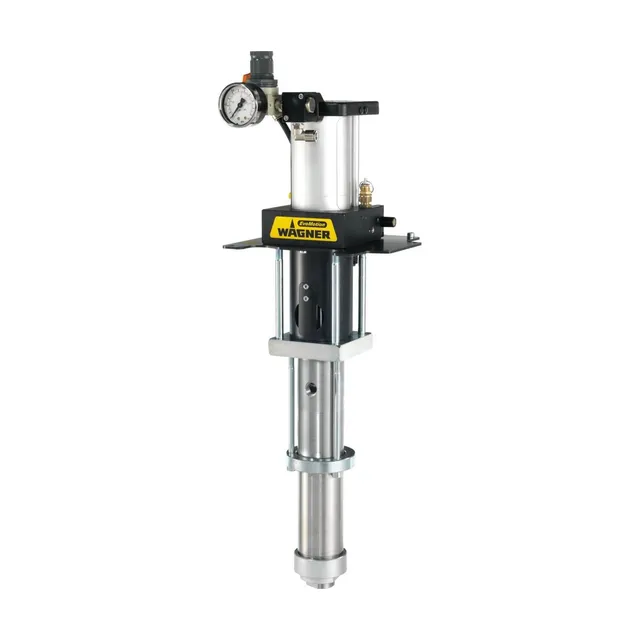
WAGNER
EvoMotion 5-60
WAGNER EvoMotion 5-60 low-pressure piston feed pump for Airspray – up to 40 bar and 3.6 l/min, also for high-viscosity materials and long hoses.
40 barPressure
- Technology
- Airspray
- Weight
- 13 kg
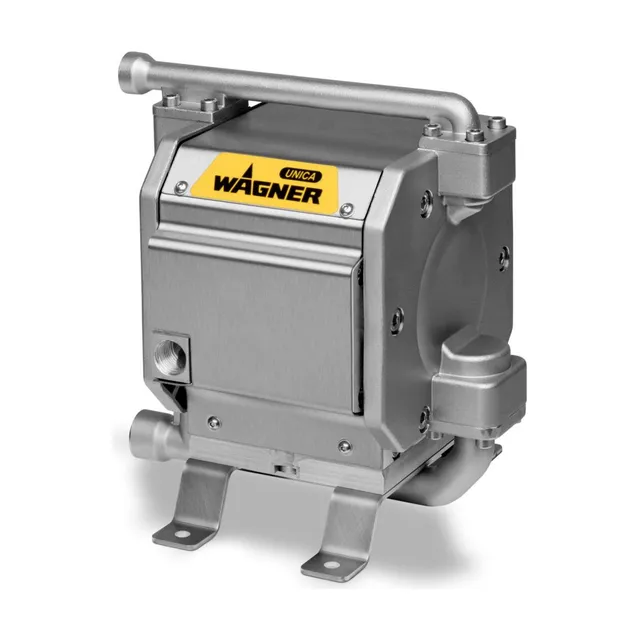
WAGNER
Unica
Double diaphragm pump WAGNER Unica with a 3.5 : 1 pressure ratio for Airspray – for thick materials, long hoses and circulation systems.
21 barPressure
- Technology
- Airspray
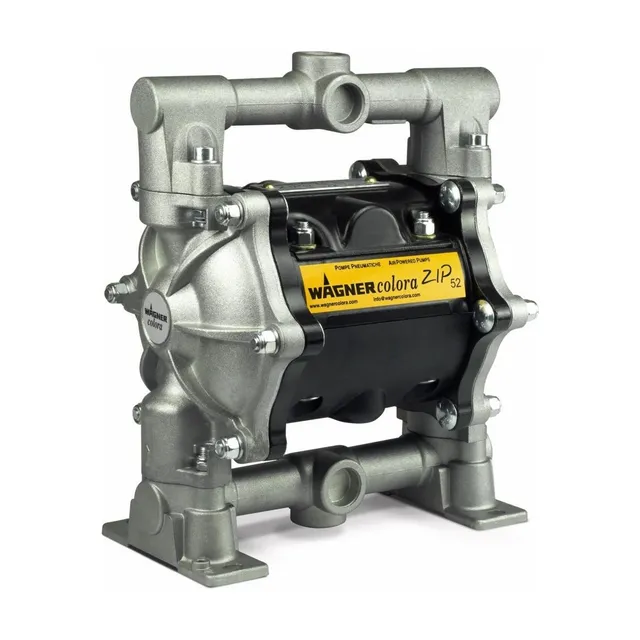
WAGNER
ZIP 52
WAGNER ZIP 52 universal double diaphragm pump for transfer and circulation of liquids – up to 8 bar and 52 l/min; also available as the ZIP 52 Finishing unit for Airspray.
8 barPressure
- Technology
- Airspray
- Weight
- depending on version
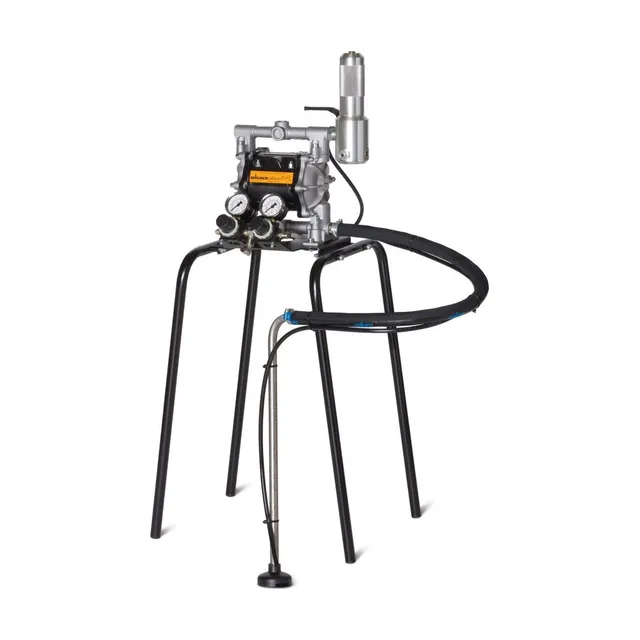
WAGNER
ZIP Eco Perfect Flow
WAGNER ZIP Eco Perfect Flow double diaphragm pump for single-gun Airspray – an affordable entry-level model up to 8 bar.
8 barPressure
- Technology
- Airspray
- Weight
- 7.9 kg
Frequently asked questions
What pressure and flow rate does the WAGNER Wildcat 10-70 deliver?
According to the manufacturer: maximum material pressure 40 bar and flow rate up to 4.2 l/min.
What is the transmission ratio and volume per double stroke of the WAGNER Wildcat 10-70?
Transmission ratio 10 : 1, volume 70 cm³ per double stroke, max. 60 strokes per minute.
What materials can the WAGNER Wildcat 10-70 handle?
According to the manufacturer, materials: water-based, solvent-based, abrasive, moisture-sensitive; material temperature 5–80 °C; pH 3.5–9.
What is the WAGNER Wildcat 10-70 designed for and which spraying method does it use?
According to the manufacturer, application method: Airspray; applications: metal, plastics, wood, release agents, bonding.
What connections does the WAGNER Wildcat 10-70 require?
Air inlet pressure 2.5–5 bar; air connection female G 1/2″; material outlet male M24x1.5.
How much does the WAGNER Wildcat 10-70 weigh and how loud is it?
Weight 17 kg; noise level at 6 bar air pressure 74 dB(A); maximum permissible inclination 10°.
What materials are the paint-contacting parts of the WAGNER Wildcat 10-70 made of?
According to the manufacturer, the paint-contacting parts of the WAGNER Wildcat 10-70 are made of the following materials: stainless steel, hard chrome, tungsten carbide, PTFE, polyethylene (PE).
Have a different question? Write to us – a technician will answer. Send an enquiry
Technical terms are explained in the glossary.