
WALTHER PILOT
WALTHER PILOT MDG 250
WALTHER PILOT MDG 250 stainless steel material pressure tank – usable volume 248 l, pressure vacuum / 6 bar.
Who it is for: material feed to spray guns, material preparation
Enquire about this productSolution: Industrial coating
The technician for your field will contact you as soon as possible. Prices are provided in our quotation.
Why WALTHER PILOT MDG 250
- Pulsation-free feedPulsation-free material feed and storage, stainless steel with high corrosion resistance.
Stainless steel pressure tanks feed and store various materials without pulsation, with high corrosion resistance and a long service life. The sturdy design is intended for demanding production environments. Optionally with agitator (manual, pneumatic).
Source of text: manufacturer’s page
Technical data
- Material
- stainless steel
- Pressure
- vacuum / 6 bar
- Agitator optional
- without agitator; manual agitator; pneumatic agitator
- Regulator optional
- single regulator; +2. regulator; +2. and 3. regulator; precision pressure regulator
- Material outlet (top/bottom)
- 3/8" / 1"
- Capacity (filling quantity/usable capacity)
- 251.0 liters / 248.0 liters
Further manufacturer data
- Outlet optional
- 1 upper outlet; 2 upper outlets; 1 lower outlet
- Diameter (inside/outside)
- 692mm / 706mm
- Total height without agitator (upper / lower outlet)
- 1152mm
- Total height with manual agitator (upper / lower outlet)
- 1304mm
- Total height with pneumatic agitator (upper / lower outlet)
- 1227mm
- Total height with electric agitator (upper / lower outlet)
- 1371mm
Data are taken from manufacturer documentation. We will verify them for your application before you order. Request a technical data sheet
How it works
How spraying from a pressure tank works
In a closed tank, compressed air presses on the material and forces it through a hose to the spray gun – evenly and without pulsation, without an electrically driven pump. The spray gun also receives atomising air separately.
Select a step or click a part of the diagram – we will show what it does, related terms, questions and products.
- Compressed air
- Paint / material
Description of all parts
- Air
Compressed air from the supply goes to the tank regulator and separately to the spray gun as atomising air.
- Compressed air supply
Compressed air from the workshop supply. - Atomising air
Air for the spray gun is supplied separately from the material, through an air hose.
- Compressed air supply
- Pressure regulation
The regulator with pressure gauge sets the pressure in the tank – and thus the amount of material flowing to the spray gun.
- Tank pressure regulator
Sets the pressure in the tank. Depending on the version, tanks have one or more regulators, including a precision regulator.
- Tank pressure regulator
- Pressure tank
The air presses on the material in the closed tank and forces it out at constant pressure. The material can be mixed with an agitator; the tank may only be filled after the pressure has been released.
- Pressure tank: MDG 250
Closed tank in which air presses on the material. Delivery is pulsation-free; the agitator can be manual, pneumatic or electric. Without an additional pump, the material cannot be circulated.
Advantages: constant pressure and gentle handling of sensitive materials (adhesives, UV, reactive). Limitations: lower material pressure, less suitable for high viscosity, and refilling is only possible after releasing the pressure. A pump is better for high pressure, frequent colour changes and circulation.
- Pressure tank: MDG 250
- Hose
The material hose carries the material from the top or bottom outlet of the tank to the spray gun.
- Material hose
Carries the material from the tank to the spray gun.
- Material hose
- Spray gun
The spray gun atomises the material with atomising air from the air cap.
- Spray gun
Air spray gun: air from the slot of the air cap atomises the material, and the side holes adjust the spray pattern.
Material flow depends on the nozzle diameter and the tank pressure; it is fine-tuned with the needle stroke adjustment screw.
WAGNER spray guns and atomisers →
WALTHER PILOT spray guns →
- Spray gun
Simplified principle. Unpressurised tanks (e.g. FMB) are used to prepare and supply material for a pump – they do not work this way. We will select the number of regulators and the tank outlet according to the application.
Source: WALTHER PILOT – WaltherWiki, pressure tanks and spraying methods; data sheets for MDG and LDG tanks (walther-pilot.de, wagner-group.com).
Similar models – WALTHER PILOT pressure and unpressurised tanks
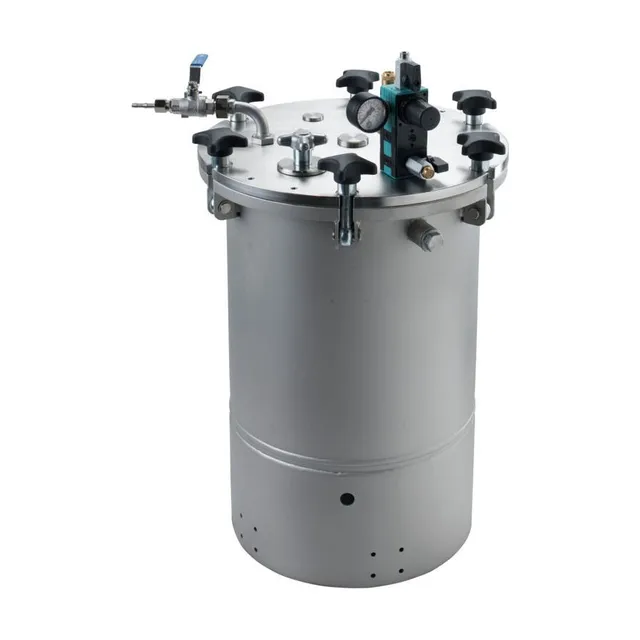
WALTHER PILOT
MDG 45 Modular
WALTHER PILOT MDG 45 Modular stainless steel material pressure tank in a modular system – pressure 6 bar.
6 barPressure
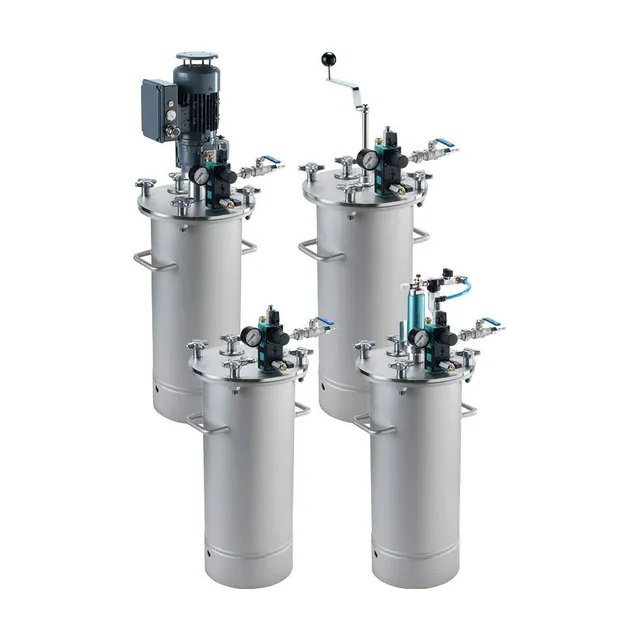
WALTHER PILOT
MDG 24
WALTHER PILOT MDG 24 stainless steel material pressure tank – usable volume 23.5 l, pressure 6 bar.
6 barPressure
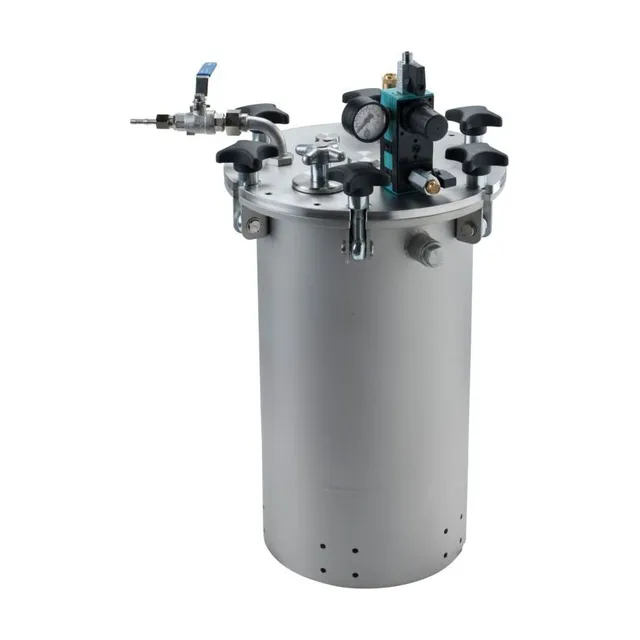
WALTHER PILOT
MDG 22 Modular
WALTHER PILOT MDG 22 Modular stainless steel material pressure tank in a modular system – pressure 6 bar.
6 barPressure
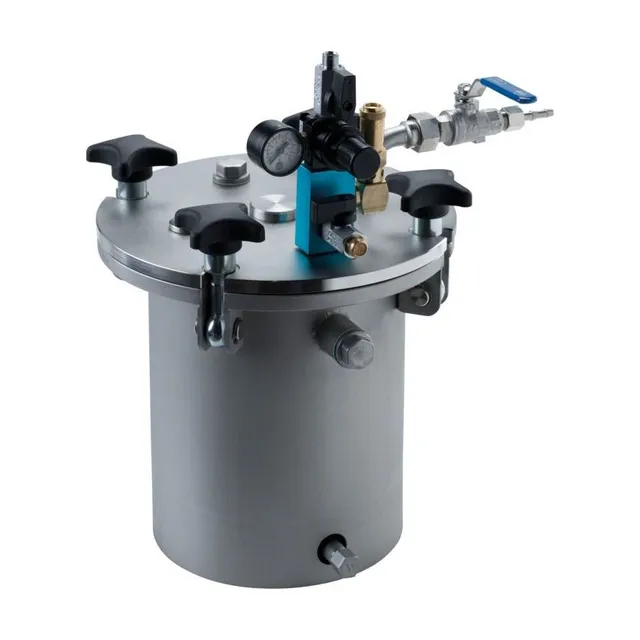
WALTHER PILOT
MDG 8 Modular
WALTHER PILOT MDG 8 Modular stainless steel material pressure tank in a modular system – pressure 4 bar.
4 barPressure
Frequently asked questions
What material pressure is WALTHER PILOT MDG 250 designed for?
Technical data according to the manufacturer for WALTHER PILOT MDG 250 – pressure range vacuum / 6 bar.
What volume and equipment does WALTHER PILOT MDG 250 have?
Volume (filling / usable) 251 l / 248 l; agitator: without agitator, manual agitator, pneumatic agitator; outlet: 1 top outlet, 2 top outlets, 1 bottom outlet.
What material is WALTHER PILOT MDG 250 made of?
Technical data according to the manufacturer for WALTHER PILOT MDG 250 – material: stainless steel.
Have a different question? Write to us – a technician will answer. Send an enquiry
Technical terms are explained in the glossary.