Article
Washing parts and containers: spray or ultrasound?
Published
A parts and container washer can either rinse off dirt with a jet of liquid from nozzles or loosen it with ultrasound in a bath. We explain how both principles work, when each is suitable and how the washing liquid is returned to circulation.

What IST washers clean
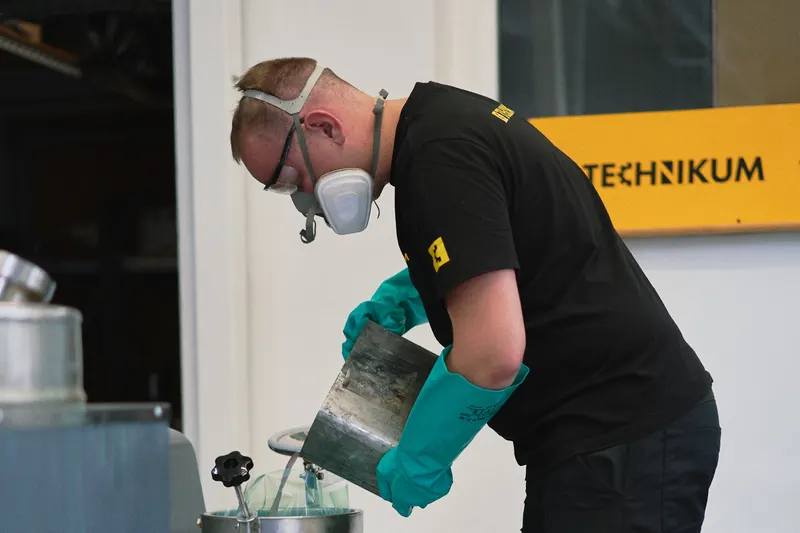
IST washers cover almost everything that gets dirty in painting and paint manufacturing: parts, containers and even large tanks. According to IST, washing changes from manual work to an automated process, and operators come into less contact with solvents.
- metal parts, mechanical components, buckets and containers – PN-S PLUS; parts placed on trolleys – XTR-M
- paint cans and containers – BW; according to IST, a contaminated container changes from hazardous waste to ordinary waste, or to a reusable container
- IBC containers and process, storage or transport tanks – TW (see washing IBCs and tanks)
- small and fragile parts by hand in a closed tub through sealed gloves – EASY WASH
- printing machine parts, doctor blades and ink reservoirs with water and detergents – EL and EXL
- anilox rollers and flexographic printing plates – specialised LR-C, LVA and LCA machines
How spray washing works
In spray washing, a pump draws the washing liquid from the machine's tank and a number of nozzles spray it onto the parts at high pressure. The liquid acts mechanically through the force of the jet and at the same time chemically according to the agent used. At the end of the cycle, the used liquid is collected, filtered and returned to the tank.
The pump and nozzles differ from machine to machine. The BW drives a rotating washing head with a pneumatic double-diaphragm pump, the XTR-M has oscillating hoses with flat nozzles that spray at different angles, and the TW moves the washing head on a mobile carrier and pushes the liquid with a high-pressure pump.
The washing liquid is a solvent or an aqueous solution. The PN-S PLUS, BW, EASY WASH and XTR-M are also designed for flammable solvents. The EL and EXL work only with non-flammable liquids – water and acidic or alkaline detergents – and heat the liquid. The TW is made in both a solvent and a water version.
How it works
How spray washing works
The pump draws washing liquid from the tank and the nozzles spray it under pressure onto the parts or into the container. The used liquid is collected, filtered and returned to the tank. Contaminated solvent can be cleaned by distillation.
Select a step or click a part of the diagram – we will show what it does, related terms, questions and products.
- Contaminated liquid
- Clean liquid
Description of all parts
- Loading
Parts, containers, drums or IBCs are placed in the washer's working chamber.
- Washer working chamber
Parts or containers are placed here. For flammable solvents, the machines are built for potentially explosive atmospheres (ATEX).
Caution: the EL and EXL are intended only for non-flammable liquids (water, acidic and alkaline detergents). For flammable solvents, the PN-S, BW/SW, EASY WASH and XTR-M are available in ATEX versions.
- Washer working chamber
- Tank and pump
The washing liquid is in the machine's tank. The pump – pneumatic, electric or high-pressure depending on the machine – draws it in.
- Washing liquid tank
Reservoir of washing liquid in the machine. On the TW it is divided into washing and rinsing.
On the PN, the liquid is kept in a service tank and does not evaporate into the air. - Pump
Draws the liquid from the tank and delivers it to the nozzles. Depending on the machine, it is a pneumatic double diaphragm pump, an electric pump or a high-pressure pump.
For example, the BW drives a rotating head with a pneumatic double diaphragm pump, the EL and EXL have an electric pump with liquid heating, and the TW has a high-pressure pump with constant flow.
- Washing liquid tank
- Spraying
The nozzles spray the liquid under pressure onto the surface – it acts both mechanically and chemically.
- Washing nozzles
Spray the liquid under pressure onto the surface – for example a rotating head for containers or a washing head on a moving carrier for drums and IBCs.
The XTR-M has oscillating hoses that change the angle of impact, and blade nozzles for a stronger jet.
- Washing nozzles
- Filtration and return
The used liquid is collected, the filter retains particles and protects the pump and nozzles, and the liquid returns to the tank.
- Filter
Captures particles from the used liquid and protects the pump and nozzles.
On the TW, pressure sensors monitor filter clogging.
- Filter
- Regeneration
Spent solvent can be cleaned in a distillation unit and returned to washing.
- Distillation unit
The washer can be supplemented with a distillation unit that cleans the contaminated solvent for reuse (e.g. PN-S PLUS, TW with ROTO PLUS).
IST distillation units →
How solvent recycling by distillation works →
- Distillation unit
Simplified principle of spray washing. Ultrasonic washers (LR-C), the plate washer with brushes (LCA), high-pressure anilox washing (LVA) and manual washing (EASY WASH) work differently. Rinsing, drying and connection to distillation vary by machine.
Source: IST – general description of spray washers and the TW and PN-S PLUS catalogues (ist.it).
How ultrasonic cleaning works
In ultrasonic washing, the part is immersed in liquid and the dirt is removed not by a jet but by cavitation. A generator produces ultrasonic power and transducers transmit it into the liquid via a vibrating membrane. The alternating pressure in the liquid forms microscopic bubbles which break up the dirt as they collapse.
According to IST, ultrasound is effective and at the same time gentle: it reaches even the smallest gaps without damaging the part. It removes, for example, oil, grease, ink or paint. The manufacturer recommends it where spraying is not sufficient or where its use is restricted by regulations.
The IST ultrasonic machines in our range are designed for printing companies. The LR-C series cleans anilox rollers ultrasonically – cavitation together with the cleaning agent releases the ink even from the deepest cells of the roller. For parts and containers from the paint shop, the range includes spray washing machines.
Spray or ultrasound: a comparison
IST compares the two technologies by type of dirt, parts and operation. The table summarises its comparison.
| Aspect | Spray | Ultrasound |
|---|---|---|
| Dirt | on the surface or dried on, but accessible | deep, in gaps and cavities |
| Parts | medium-sized and large | small or geometrically complex |
| Materials | metals, stainless steel, plastics | metals, glass, ceramics, aluminium |
| Output | high, fast cycles | medium, longer but more precise cycles |
| Gentleness to the part | medium | high |
| Energy consumption | medium | low to medium, depending on frequency |
| Automation | high, the machine can be integrated into a line | high, rather for a stand-alone workstation |
| Maintenance | low, plug & play – ready for operation straight away | minimal thanks to immersion transducers |
| Typical industries | workshops, mechanical engineering, printing companies | precision manufacturing, healthcare, aerospace |
When to use spray and when ultrasound
Spray washing suits most tasks in a paint shop: containers, cans, IBC containers and parts where the dirt is on the outside and the jet can reach it. Cycles are fast and the machine can be integrated into production.
Ultrasound makes sense for small or intricate parts, for dirt in cavities and where gentle washing is required. The price is a longer cycle.
Closed loop: the liquid returns to the washing process
The washer does not discard the liquid after each cycle – it collects it, filters it and returns it to the tank. According to IST, the used liquid can be sent for treatment and reused, which reduces operating costs.
For solvent, this treatment is distillation. PN-S PLUS can be connected to a solvent recycler, tank draining and rinsing with distilled solvent can be automatic, and the liquid is kept in a service tank so it does not evaporate. How distillation works is explained in the article How solvent recycling by distillation works. Whether it pays off for you can be calculated using the guide to calculating payback.
According to IST, machine washing also saves the liquid itself. For TW, the manufacturer states 15–20 l of water and 1–3 l of solvent per container, compared with 50–75 l of water and 5–10 l of solvent for manual washing.
Flammable solvents and ATEX
When washing with flammable solvent, the machine must be designed for a potentially explosive atmosphere in accordance with the ATEX rules. PN-S PLUS, BW and EASY WASH are fully pneumatic with ATEX/EAC certification; XTR-M has its control panel in an ATEX enclosure and an electric pump in ATEX design. With flammable substances, TW earths the container and inerts it if required. EL and EXL are for non-flammable liquids only. More on zones and marking can be found in the article ATEX in the paint shop.
What to ask when choosing a washer
- What do you wash – parts, containers, cans or IBCs – and how large and intricate are they?
- Where is the dirt: on the surface, or in cavities and gaps?
- What liquid do you wash with: flammable solvent, or water with detergent?
- How many pieces need to be washed per shift, and should the machine run in an automatic cycle, or is manual washing sufficient?
- What will happen to the used liquid – will it go to distillation, or be disposed of as waste?
- Where will the machine stand, and is it a potentially explosive atmosphere?
How to choose a washer
Write down your answers to these questions and take a look at the parts, container and IBC washers. If you wash with solvent, bring us a sample of the used solvent – as part of our demonstrations and trials we will try to recycle it and you will see how much of it can be returned to washing.
Is this an issue in your plant?
Tell us what you need – the technician for your area will get back to you.
Your technician
Lukáš Rybár
IST Manager – solvent recycling
- Phone – Lukáš Rybár: +421 948 855 000
- E-mail – Lukáš Rybár: rybar@
technikum.sk - Lukáš on LinkedIn
- Speaks: English, Slovak, Czech
Do you have a question on this topic?The AI adviser answers immediately
Your technician
Lukáš Rybár
IST Manager – solvent recycling
- Phone – Lukáš Rybár: +421 948 855 000
- E-mail – Lukáš Rybár: rybar@
technikum.sk - Lukáš on LinkedIn
- Speaks: English, Slovak, Czech
Frequently asked questions
How does spray washing of parts work?
In spray washing, a pump draws the washing liquid from the machine's tank and a number of nozzles spray it onto the parts at high pressure. The liquid acts mechanically through the force of the jet and at the same time chemically according to the agent used. At the end of the cycle, the used liquid is collected, filtered and returned to the tank.
How does ultrasonic washing of parts work?
In ultrasonic washing, the part is immersed in liquid and the dirt is removed not by a jet but by cavitation. A generator produces ultrasonic power and transducers transmit it into the liquid via a vibrating membrane. The alternating pressure in the liquid forms microscopic bubbles which break up the dirt as they collapse.
When is spray washing suitable?
Spray washing suits most tasks in a paint shop: containers, cans, IBC containers and parts where the dirt is on the outside and the jet can reach it. Cycles are fast and the machine can be integrated into production.
Have a different question? Write to us – a technician will answer. Send an enquiry
Technical terms are explained in the glossary.