
WALTHER PILOT
WALTHER PILOT MDG 120
WALTHER PILOT MDG 120 stainless steel material pressure tank – usable volume 120 l, pressure vacuum / 1.5 bar / 6 bar.
Who it is for: material feed to spray guns, material preparation
Enquire about this productSolution: Industrial coating
The technician for your field will contact you as soon as possible. Prices are provided in our quotation.
Why WALTHER PILOT MDG 120
- Pulsation-free feedPulsation-free material feed and storage, stainless steel with high corrosion resistance.
Stainless steel pressure tanks feed and store various materials without pulsation, with high corrosion resistance and a long service life. The sturdy design is intended for demanding production environments. Optionally with agitator (manual, pneumatic, electric).
Source of text: manufacturer’s page
Technical data
- Material
- stainless steel
- Pressure
- vacuum / 1.5 bar / 6 bar
- Agitator optional
- without agitator; manual agitator; pneumatic agitator; electric agitator
- Regulator optional
- single regulator; +2. regulator; +2. and 3. regulator; precision pressure regulator
- Material outlet (top/bottom)
- 3/8" / 1"
- Capacity (filling quantity/usable capacity)
- 138.0 liters / 120.0 liters
Further manufacturer data
- Outlet optional
- 1 upper outlet; 2 upper outlets; 1 lower outlet
- Diameter (inside/outside)
- 442mm / 456mm
- Total height without agitator (upper / lower outlet)
- 1263mm
- Total height with manual agitator (upper / lower outlet)
- 1413mm
- Total height with pneumatic agitator (upper / lower outlet)
- 1336mm
- Total height with electric agitator (upper / lower outlet)
- 1480mm
Data are taken from manufacturer documentation. We will verify them for your application before you order. Request a technical data sheet
How it works
How spraying from a pressure tank works
In a closed tank, compressed air presses on the material and forces it through a hose to the spray gun – evenly and without pulsation, without an electrically driven pump. The spray gun also receives atomising air separately.
Select a step or click a part of the diagram – we will show what it does, related terms, questions and products.
- Compressed air
- Paint / material
Description of all parts
- Air
Compressed air from the supply goes to the tank regulator and separately to the spray gun as atomising air.
- Compressed air supply
Compressed air from the workshop supply. - Atomising air
Air for the spray gun is supplied separately from the material, through an air hose.
- Compressed air supply
- Pressure regulation
The regulator with pressure gauge sets the pressure in the tank – and thus the amount of material flowing to the spray gun.
- Tank pressure regulator
Sets the pressure in the tank. Depending on the version, tanks have one or more regulators, including a precision regulator.
- Tank pressure regulator
- Pressure tank
The air presses on the material in the closed tank and forces it out at constant pressure. The material can be mixed with an agitator; the tank may only be filled after the pressure has been released.
- Pressure tank: MDG 120
Closed tank in which air presses on the material. Delivery is pulsation-free; the agitator can be manual, pneumatic or electric. Without an additional pump, the material cannot be circulated.
Advantages: constant pressure and gentle handling of sensitive materials (adhesives, UV, reactive). Limitations: lower material pressure, less suitable for high viscosity, and refilling is only possible after releasing the pressure. A pump is better for high pressure, frequent colour changes and circulation.
- Pressure tank: MDG 120
- Hose
The material hose carries the material from the top or bottom outlet of the tank to the spray gun.
- Material hose
Carries the material from the tank to the spray gun.
- Material hose
- Spray gun
The spray gun atomises the material with atomising air from the air cap.
- Spray gun
Air spray gun: air from the slot of the air cap atomises the material, and the side holes adjust the spray pattern.
Material flow depends on the nozzle diameter and the tank pressure; it is fine-tuned with the needle stroke adjustment screw.
WAGNER spray guns and atomisers →
WALTHER PILOT spray guns →
- Spray gun
Simplified principle. Unpressurised tanks (e.g. FMB) are used to prepare and supply material for a pump – they do not work this way. We will select the number of regulators and the tank outlet according to the application.
Source: WALTHER PILOT – WaltherWiki, pressure tanks and spraying methods; data sheets for MDG and LDG tanks (walther-pilot.de, wagner-group.com).
Similar models – WALTHER PILOT pressure and unpressurised tanks
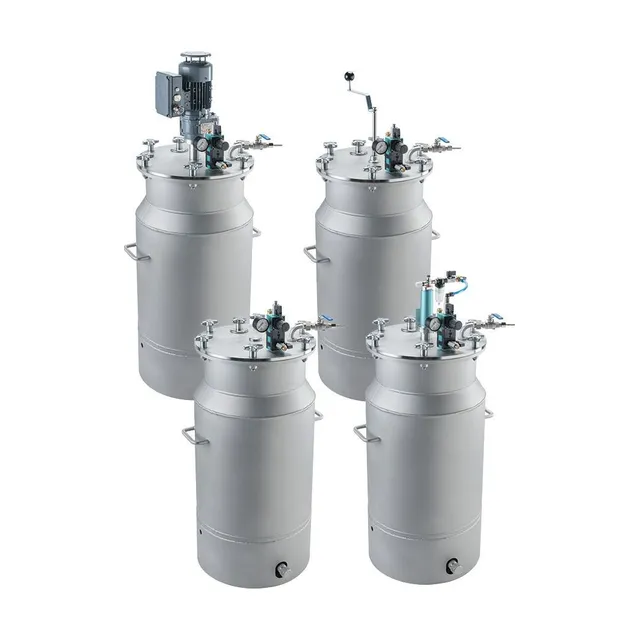
WALTHER PILOT
MDG 90
WALTHER PILOT MDG 90 stainless steel material pressure tank – usable volume 90 l, pressure vacuum / 2 bar / 6 bar.
vacuum / 2 bar / 6 barPressure
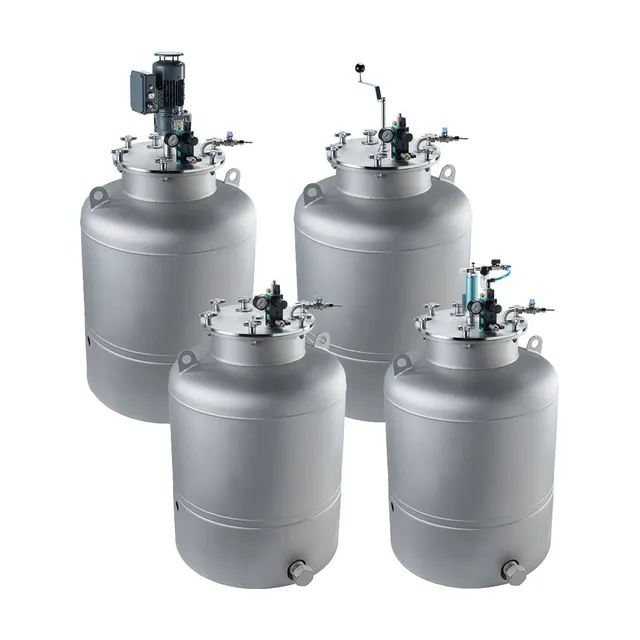
WALTHER PILOT
MDG 250
WALTHER PILOT MDG 250 stainless steel material pressure tank – usable volume 248 l, pressure vacuum / 6 bar.
vacuum / 6 barPressure
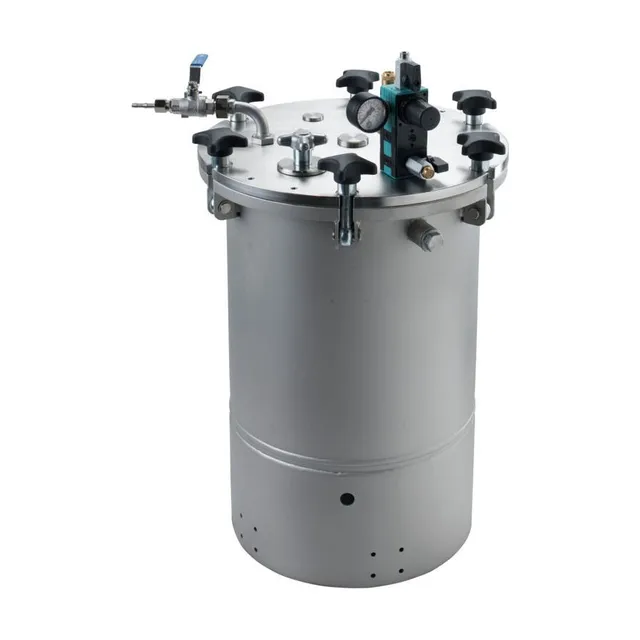
WALTHER PILOT
MDG 45 Modular
WALTHER PILOT MDG 45 Modular stainless steel material pressure tank in a modular system – pressure 6 bar.
6 barPressure
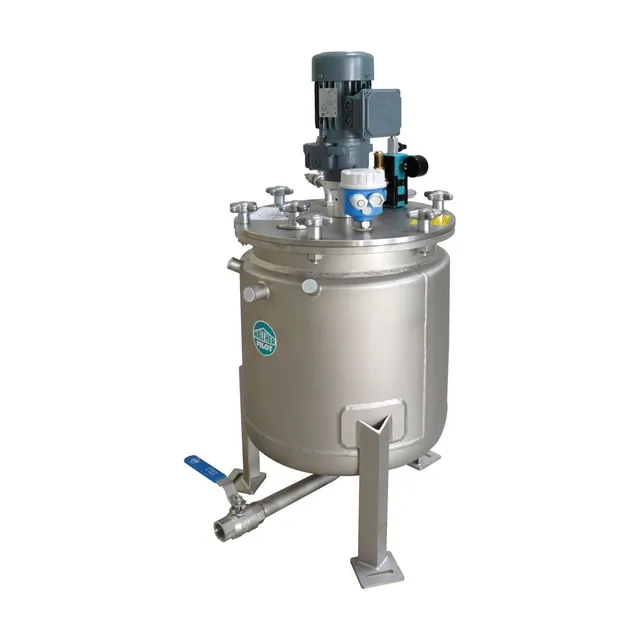
WALTHER PILOT
Special tanks
WALTHER PILOT special pressure tanks in steel and stainless steel up to approx. 2,000 litres – single or double jacket, based on the MDG series or to customer specification.
Frequently asked questions
What material pressure is WALTHER PILOT MDG 120 designed for?
Technical data according to the manufacturer for WALTHER PILOT MDG 120 – pressure range vacuum / 1.5 bar / 6 bar.
What volume and equipment does WALTHER PILOT MDG 120 have?
Volume (filling / usable) 138 l / 120 l; outlet: 1 top outlet, 2 top outlets, 1 bottom outlet.
What material is WALTHER PILOT MDG 120 made of?
Technical data according to the manufacturer for WALTHER PILOT MDG 120 – material: stainless steel.
Have a different question? Write to us – a technician will answer. Send an enquiry
Technical terms are explained in the glossary.