Article
2K materials and mixing systems: ratio, pot life and dosing
Published
A two-component lacquer only works if the base and hardener are mixed in the correct ratio and the mixture is processed before it sets. We explain how the components are mixed, how an electronic system maintains the ratio and what to look for when choosing a system.

What is a 2K material
A two-component (2K) material consists of two components – the base (component A, for example the paint) and the hardener (component B) – which must be mixed in an exact ratio shortly before application. Every 2K material therefore raises two questions: in what ratio it is mixed and how long the mixture can be processed.
After mixing, a chemical reaction takes place between the components and the coating cures. Compared with single-component paints, 2K coatings offer higher resistance to mechanical damage, chemicals and weathering, a longer service life and better storability, and they use less solvent.
Some materials also have a third or fourth component, which is why we speak of 3K and 4K. The third component can be a thinner, for example: according to WAGNER, an electronic system can use it to thin high-viscosity material directly during work instead of thinning it by hand.
- When wet, the layer contains solids (pigments, binder) and solvent.
- The solvent evaporates and the solids remain on the part – the layer becomes thinner.
- With 2K, the hardener chemically cross-links the base. The material contains less solvent, so a wet layer leaves a thicker dry layer.
Simplified diagram; layer proportions are for illustration only.
Mixing ratio: why it has to be right
The mixing ratio states how much hardener is added to the base (A : B) and is specified in the paint’s technical data sheet – in parts by volume or by weight, for example 4 : 1. Homogeneous mixing is just as important as the ratio; without it the coating will not have the required properties.
Mixing is made more difficult by the different viscosities of components A and B. Heating the more viscous component helps.
Manufacturers of 2K systems state two figures: the range of ratios the system can handle and the mixing accuracy. According to WAGNER, the precise interplay of measuring, dosing and control is decisive for a uniform mixture – only then does the coating quality remain constant even under changing conditions.
Pot life
The pot life is the time during which the mixed 2K material can still be processed; after that it sets. This applies both to the mixture in a container and to the mixture standing in the hose and spray gun when no spraying is taking place.
Once the pot life has expired, the viscosity rises and the mixture cures. It clogs and destroys any hoses and lines in which it has remained.
Heat shortens the pot life. A higher material or ambient temperature does lower the viscosity, but it accelerates the reaction.
Electronic systems therefore monitor the pot life. It is entered in the recipe together with the ratio; when no spraying is taking place, the system warns in advance that the pot life is about to expire and, once it has expired, stops until the mixture has been flushed out. If the guns are in a flushing box, it can also start flushing by itself. On the WAGNER 2K Smart it is monitored separately for each of the two guns.
How the components are mixed
The mixing method determines who maintains the ratio – a person, the gun settings or the measuring technology.
| Method | Who maintains the ratio | Where it is used |
|---|---|---|
| manual mixing in a container before filling | the painter, for each batch | conventional method without a mixing system |
| mixing in the gun’s spray jet (external) | nozzle size, component pressure, needle stroke | 2K adhesives and mirror coating (WALTHER PILOT Misch-N, 2K-Bonding); the automatic WA560-2K also for 2K lacquers and paints after a material trial |
| electronic dosing | flow meter and control unit | multi-colour 2K to 4K lacquers, lines and robots |
In the conventional method, the components are mixed outside the spraying system and a container is filled with the mixture. The painter has to monitor both the accuracy of the ratio and the pot life, a lot of cleaning material is consumed and cleaning takes a long time. WAGNER mixing systems (2K Smart, 2K Comfort, TwinControl) maintain the set ratio and homogeneous mixing by themselves.
With external mixing, the components are fed to the gun separately and only meet in the spray jet. WALTHER PILOT guns work in this way with a ratio of approximately 1 : 1 (Pilot Misch-N), 4 : 1 to 12 : 1 (Pilot 2K-Bonding) or 1 : 1 to 13 : 1 (automatic WA560-2K).
Manual mixing
- Components A and B are mixed in advance in a container – the painter measures the ratio for every batch.
- The mixture fills the pump, hose and gun – the whole system is full of mixed material.
- The pot life starts running from the moment of mixing. After that the mixture hardens in the container, pump and hoses.
- Unused mixture is waste and the whole system has to be flushed.
Mixing system
- Components A (base) and B (hardener) stay in separate containers and pumps until spraying. There can be several of each component – for example, 2K Comfort handles up to 25 colours and several hardeners; optionally a component C – thinner for adjusting viscosity – and flushing-solvent pumps are added. A colour-change block switches between colours.
- The system meters both components and doses them at the set ratio.
- The components are only mixed in the mixing block – the mixture is only in the hose to the gun.
- During a break or a colour change, the flushing solvent flushes only the section containing the mixture – the mixer, hose and gun.
What a 2K system consists of
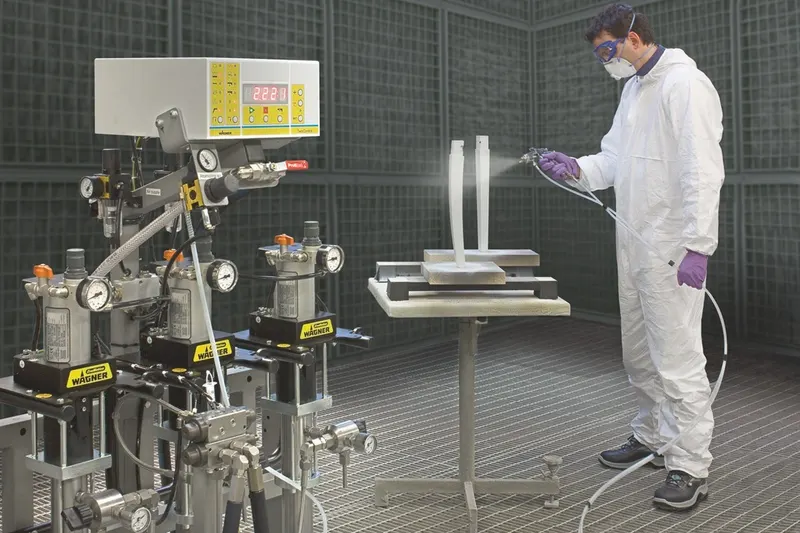
An electronic 2K system performs five functions – from the pump to the mixer:
- supply – each component has its own pump, piston or diaphragm, for low or high pressure,
- measuring – a flow meter or stroke sensor determines how much of each component has passed,
- dosing – pneumatic valves let in paint, hardener and flushing agent; the hardener is injected into the base by a dosing valve,
- control – the control unit monitors the ratio, triggers an alarm on deviation and can communicate with a robot,
- mixing – a static mixer blends the components homogeneously just before the hose to the gun.
The simplest system is TwinControl: base and flushing agent pass through the colour change valve, the hardener through the dosing valve, and directly below this block is the static mixer. The 2K Smart and 2K Comfort units add colour and hardener change blocks and flow meters for each component.
How an electronic system maintains the ratio
An electronic 2K system measures the quantity of each component with a flow meter and doses the hardener accordingly. WAGNER offers three measuring systems, which can also be combined:
- gear flow meter – fast response; in the complete 2K Smart C system it is used with double diaphragm pumps,
- Coriolis flow meter – low wear,
- WAGNER stroke sensor – measures indirectly, without contact with the material, which makes it suitable for abrasive materials; used with piston pumps.
The hardener is injected into the base through a valve. The WAGNER AIS (Adaptive Injection System) adapts the hardener injection to the changing flow rate, so the ratio stays the same at both low and high consumption. The systems monitor the exact ratio during work and trigger an alarm if it deviates from the tolerance; on the 2K Comfort, process data can be recorded on a computer.
With injection mixing, the base flows continuously and the hardener is injected into it in short doses; with alternating mixing, the components are fed into the mixer alternately in larger doses. With injection, the ratio is set by the pressure of the hardener pump, which must be higher than the base pressure, and by the stroke of the injection valve. The smaller the doses, the more uniform the mixture, and the ratio is correct from the start.
At low pressure, measuring and dosing can be combined in a gear pump that both meters and doses the hardener. Even then, however, it needs a feed pump.
Material supply also affects accuracy. According to WAGNER, many 2K system downtimes are caused not by the mixing unit itself but by the feed pumps.
Flushing and colour change
When changing colour and after work, the mixed material is flushed out with flushing agent. The shorter the path of the mixture, the less material and thinner the flushing consumes.
According to WAGNER, a colour change on the 2K Comfort takes less than a minute and saves up to 90 % of thinner, because only the hose to the gun is flushed. Two guns can be controlled and flushed separately, which according to WAGNER reduces waste by 50 % compared with conventional distribution valves.
Practical tips: less solvent and waste
From WAGNER’s practical recommendations for 2K systems:
- The smallest pump and hose diameter that still deliver the required output – a smaller volume leaves less mixture to flush.
- Short hoses, especially after the mixer, and short suction hoses with a low suction height.
- In low-pressure applications, flushing with alternating air and solvent.
- With a short pot life or very expensive material, an external mixer close to the gun – the mixture is only in a short section.
- Gun flush box: when the operator goes on a break and the pot life is running, flushing starts automatically, and on restart the system refills itself.
Never alternate different materials, such as polyurethane and epoxy, in one circuit. Units with two circuits are designed for such work; if both the primer and the topcoat have a long pot life, two circuits also save a lot of flushing.
What to look for when choosing
- Number of paints and components – how many bases, hardeners and third components the system has to handle.
- Mixing ratio – whether the system’s range covers the ratios of all your materials and with what accuracy.
- Flow rate and pressure – according to the number of guns and the spraying method: Airspray, Airless or AirCoat.
- Material – viscosity, waterborne or solvent-based, abrasive, sensitive to moisture. For acid-curing lacquers, the 2K Smart can be configured with a hardener section made of high-alloy stainless steel.
- Incompatible materials – systems with two circuits keep the materials physically separate.
- Environment and line – version for explosive atmospheres and connection to a robot or line control (fieldbus); see also ATEX in the paint shop.
WAGNER 2K Smart, 2K Comfort and 2K Comfort XL
The three WAGNER electronic mixing and dosing systems differ mainly in the number of colours, flow rate and pressure. All of them work with a ratio of 0.1 – 50 : 1 and with Airspray, Airless and AirCoat technology.
| Parameter | 2K Smart | 2K Comfort | 2K Comfort XL |
|---|---|---|---|
| paints (component A) | up to 5 | up to 25 | up to 10 |
| components | 2K and 3K (up to 2 hardeners, 1 third component) | 2K, 3K and 4K | 4 components (B hardeners up to 5, C and D components up to 5) |
| mixing accuracy | 1 % | 1 % | 2 % |
| max. material pressure | 250 bar | 325 bar | 530 bar |
| max. flow rate | 3 l/min | 7 l/min | 25 l/min |
| material viscosity | 20 – 2,200 mPa·s | 20 – 2,200 mPa·s | 20 – 10,000 mPa·s |
| spray guns | max. 2, separate pot life monitoring and flushing | max. 4 | depending on configuration |
| two material circuits | – | in the 2K Comfort 2-circuit version | yes |
The 2K Smart is a compact system with short material paths; in the 2K Smart C version it is supplied as a complete system including paint supply, on a stand with pumps and hoses. The 2K Comfort is designed for extensive multi-colour painting; the two-circuit version sprays two different materials simultaneously. The 2K Comfort XL is a larger range for high flow rates and pressures, for example also for protective coatings; it measures with a gear flow meter, a stroke sensor or a Coriolis flow meter.
How to choose a 2K system for your materials
List the materials you paint – the number of paints and hardeners, mixing ratios, pot lives and consumption per hour. With this information, a suitable system can be selected from the range of WAGNER 2K mixing systems and verified during a demonstration at the Industrial Coating Centre (showroom and test centre in Trnava), where you can try spraying your own products.
Is this an issue in your plant?
Tell us what you need – the technician for your area will get back to you.
Your technician
Peter Kovár
WAGNER Sales Manager | SK & CZ
- Phone – Peter Kovár: +421 911 804 818
- E-mail – Peter Kovár: kovar@
technikum.sk - Speaks: Slovak, Czech
Do you have a question on this topic?The AI adviser answers immediately
Your technician
Peter Kovár
WAGNER Sales Manager | SK & CZ
- Phone – Peter Kovár: +421 911 804 818
- E-mail – Peter Kovár: kovar@
technikum.sk - Speaks: Slovak, Czech
Frequently asked questions
What does the mixing ratio of a 2K material indicate?
The mixing ratio states how much hardener is added to the base (A : B) and is specified in the paint’s technical data sheet – in parts by volume or by weight, for example 4 : 1. Homogeneous mixing is just as important as the ratio; without it the coating will not have the required properties.
What is the pot life of a 2K material?
The pot life is the time during which the mixed 2K material can still be processed; after that it sets. This applies both to the mixture in a container and to the mixture standing in the hose and spray gun when no spraying is taking place.
What advantages do 2K coatings have over single-component paints?
After mixing, a chemical reaction takes place between the components and the coating cures. Compared with single-component paints, 2K coatings offer higher resistance to mechanical damage, chemicals and weathering, a longer service life and better storability, and they use less solvent.
What is hardener injection in 2K mixing?
The base flows continuously and the hardener is injected into it by a dosing valve in short doses. The ratio is set by the pressure of the hardener pump, which is higher than the base pressure, and by the valve stroke; the smaller the doses, the more uniform the mixture.
How can I save solvent in 2K spraying?
Choose the smallest pump and hose diameter that still deliver the output, shorten the hoses, especially after the mixer, and the suction hoses. At low pressure, flush with alternating air and solvent, and with a short pot life or expensive material use an external mixer close to the gun.
Can I alternate polyurethane and epoxy in one 2K circuit?
No. Different materials are not mixed in one circuit; units with two circuits are designed for such work – they physically separate the materials and also save flushing.
Have a different question? Write to us – a technician will answer. Send an enquiry
Technical terms are explained in the glossary.