Article
Waterborne paints: what to watch out for when spraying
Published
Switching from solvent-based to waterborne paints reduces the amount of solvents, but changes the requirements for the spraying equipment. Most of all in electrostatic application, where conductive paint needs an insulated material system, but also in materials, hoses and cleaning.

Why paint shops are switching to waterborne paints
The main reason is fewer solvents in the paint shop and in the air. According to WAGNER, waterborne coating materials play an increasingly important role in environmental protection and help to comply with regulations on emissions of volatile organic compounds (VOC), because no solvent-based materials are used. For release agents, WALTHER PILOT states that waterborne ones are more environmentally friendly and safer.
However, the switch is not just a matter of replacing the paint drum. Water conducts electric current differently from solvent, and this changes above all electrostatic spraying, but also the equipment materials, cleaning and conditions in the booth.
What changes on the equipment: an overview
| Area | Solvent-based paint | Waterborne paint |
|---|---|---|
| Electrical conductivity of the paint | relatively high resistance, the paint must have at least minimal conductivity | the paint is usually conductive |
| Charging in electrostatic application | electrode directly in the gun, the voltage is discharged in the gun | internal charging (entire material system under voltage) or external charging with electrodes outside the spray jet |
| Pump and paint container | no special insulation | insulated with internal charging – enclosed room, fence or high-voltage-resistant cabinet |
| Material hose | with overly conductive paint, a special insulated high-voltage-resistant hose | under high voltage with internal charging, must be insulated |
| Parts in contact with the material | WAGNER pumps are suitable for both types | manufacturers specify stainless steel for equipment for waterborne paints |
| Cleaning | cleaning solution for solvent-based paints | water or a flushing agent compatible with the paint |
Electrostatic application with waterborne paint: why an insulated system
Waterborne paint is conductive, so in electrostatic spraying the high voltage does not stop at the gun. With solvent-based paint, the voltage is discharged in the gun, so the painter is not exposed to any danger. With waterborne paint and internal charging, the entire material system – gun, hose, pump and paint container – is under high voltage and must be insulated for safety reasons.
According to WAGNER, there are two ways to do this:
- internal charging – the paint kitchen is separated by an enclosed room or a fence, or the entire material system is placed in a high-voltage-resistant cabinet,
- external charging – the paint is charged by electrodes outside the spray jet and the atomiser is not live; used mainly with high-speed rotary atomisers, the material saving is somewhat lower, but the entire system does not need to be insulated.
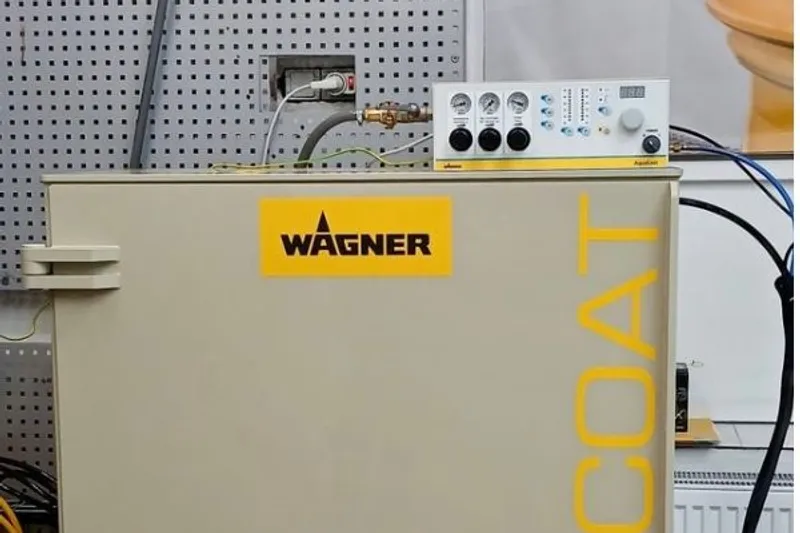
The cabinet solution is WAGNER AquaCoat: a fully insulated set with a control unit, pump and gun for manual or automatic spraying using Airspray and AirCoat technology. The paint container can only be accessed once the system has been fully discharged, the inside of the cabinet is mechanically locked during spraying, the most important safety systems are duplicated, and with manual guns the discharge energy is limited to 350 mJ. The manual guns are designed for most waterborne materials with a specific resistance from 1 kΩ·cm to 1 MΩ·cm.
According to WAGNER, electrostatic application with AquaCoat saves up to 50 % of material and shortens painting time by up to 20 % compared with conventional spraying. More on the principle and conditions, such as earthing the part, can be found in the article Electrostatic spraying of liquid paints. We demonstrate AquaCoat at the Industrial Coating Centre (showroom and test centre in Trnava) – you can bring your own parts to a demonstration.
Hoses: insulation and ease of work
With internal charging, the material hose is part of the live system and must therefore be insulated. AquaCoat manual guns have a special, permanently connected material hose. WAGNER states that the flexible DN 3 hose and the lightweight GM 5020 manual gun make the painter's work easier during longer spraying.
The hose also affects the choice of pump. According to WAGNER, the pressure loss is determined by the length and diameter of the hose, the paint viscosity and the flow rate – the pump must deliver sufficient pressure and volume for all guns at the same time.
Materials in contact with water: stainless steel
When choosing equipment for waterborne paints, check what the parts in contact with the material are made of. WAGNER states that all of its pumps are suitable for both solvent-based and waterborne materials; for example, on Puma piston pumps the entire fluid section is made of stainless steel. On the WALTHER PILOT III-F manual gun, all parts in contact with the material are made of stainless steel, and the manufacturer states that it handles waterborne paints without any problems.
If you are planning the switch with older equipment, check the material of the parts in contact with the paint in the technical data or with us – according to WALTHER PILOT, stainless steel is resistant and protects against corrosion.
Cleaning and flushing with water
Waterborne paints are flushed with water or a flushing agent that is compatible with the paint – its suitability is determined by the paint manufacturer (safety data sheet). According to WAGNER's industrial manuals, flushing is done through the return valve and the gun without a nozzle until clean liquid comes out. Solvent-based paints are cleaned with a cleaning solution.
With an insulated system, one more rule applies: the paint container can only be accessed once the system has been fully discharged. For quick paint changes, AquaCoat has a large hinged door, optionally with a window for checking the level. According to WAGNER, electrostatic application also reduces contamination and cleaning work, because overspray is minimal.
Temperature and air in the booth
Waterborne paint is more sensitive to conditions in the booth. In one of WAGNER's references, a customer considered waterborne paint, but to process it reliably they would have had to make extensive modifications to the air supplied to the booth – and stayed with a high-solids solvent-based paint. When planning the switch, ask your paint supplier for the application and drying conditions (air temperature and humidity) and check whether your booth can maintain them.
The equipment also has its range. For the GM 5020 EACW electrostatic manual gun for waterborne paints, WAGNER states an operating temperature of 5–40 °C and a material pressure of up to 250 bar. Store the equipment in an enclosed room within the temperature range given in the manual (for example −20 to +60 °C for the Cobra pump), and before storage flush the paint and water out of it as described in the manual. The storage conditions for the paint and protection against frost are specified in the paint manufacturer's technical data sheet.
How to prepare for the switch
Before the switch, write down what you spray today, with which technology and whether you use electrostatic application. This determines whether replacing some parts is enough or whether an insulated system is needed. Send it to us and we will propose a procedure. Guns for waterborne paints can be found among the WAGNER spray guns.
Is this an issue in your plant?
Tell us what you need – the technician for your area will get back to you.
Your technician
Peter Kovár
WAGNER Sales Manager | SK & CZ
- Phone – Peter Kovár: +421 911 804 818
- E-mail – Peter Kovár: kovar@
technikum.sk - Speaks: Slovak, Czech
Do you have a question on this topic?The AI adviser answers immediately
Your technician
Peter Kovár
WAGNER Sales Manager | SK & CZ
- Phone – Peter Kovár: +421 911 804 818
- E-mail – Peter Kovár: kovar@
technikum.sk - Speaks: Slovak, Czech
Frequently asked questions
Why are paint shops switching to waterborne paints?
The main reason is fewer solvents in the paint shop and in the air. According to WAGNER, waterborne coating materials play an increasingly important role in environmental protection and help to comply with regulations on emissions of volatile organic compounds (VOC), because no solvent-based materials are used. For release agents, WALTHER PILOT states that waterborne ones are more environmentally friendly and safer.
Why does waterborne paint need an insulated system in electrostatic application?
Waterborne paint is conductive, so in electrostatic spraying the high voltage does not stop at the gun. With solvent-based paint, the voltage is discharged in the gun, so the painter is not exposed to any danger. With waterborne paint and internal charging, the entire material system – gun, hose, pump and paint container – is under high voltage and must be insulated for safety reasons.
What are waterborne paints flushed with?
Waterborne paints are flushed with water or a flushing agent that is compatible with the paint – its suitability is determined by the paint manufacturer (safety data sheet). According to WAGNER's industrial manuals, flushing is done through the return valve and the gun without a nozzle until clean liquid comes out. Solvent-based paints are cleaned with a cleaning solution.
Have a different question? Write to us – a technician will answer. Send an enquiry
Technical terms are explained in the glossary.