Article
Heavy-duty corrosion protection: three coating layers and Airless spraying
Published
Steel on bridges, tanks or ships is protected by a multi-layer coating in which each layer has a different job. The materials are thick, filled and applied in heavy layers – which is why they are sprayed with Airless technology using a powerful pump and a robust gun.

Where heavy-duty corrosion protection is used
Heavy-duty corrosion protection is used to protect steel structures that are exposed for long periods to weather, water or chemicals: bridges, chemical plants, tanks and containers. The demands are even higher at sea – on ships, offshore platforms, pipelines and in splash zones, the steel is attacked by salt water.
Three layers, three jobs
The system usually consists of three layers: a zinc-filled primer that protects the steel actively, an intermediate coat for mechanical resistance and adhesion, and a topcoat for appearance and UV resistance. The values in the table are approximate, taken from WAGNER training materials; for a specific material, the paint manufacturer's technical data sheet always applies.
| Layer | Function | Layer thickness | Density | Viscosity |
|---|---|---|---|---|
| primer (zinc) | active protection of the steel | usually 70 – 150 µm, max. 500 µm | 1.5 – 2.5 g/cm³ | max. 3,000 mPa·s |
| intermediate coat (e.g. epoxy, PUR) | mechanical resistance, barrier, adhesion | 100 – 500 µm | 1.5 – 2.0 g/cm³ | max. 5,000 mPa·s depending on the filler |
| topcoat | appearance, UV resistance; at sea also antifouling treatment | 150 – 500 µm | 1.5 – 2.0 g/cm³ | approx. 500 – 3,000 mPa·s |
The zinc primer lies directly on the steel. It is filled with zinc, or alternatively zinc phosphate or aluminium, and protects the steel actively – if the coating is damaged, the zinc corrodes instead of the steel as a sacrificial anode. It is usually applied at 70 – 150 µm, max. 500 µm. Since it serves mainly as a filler and sacrificial anode, its viscosity should not be high – according to WAGNER, max. 3,000 mPa·s.
The intermediate coat gives the system its mechanical strength, forms a barrier and bonds the primer to the topcoat. It is usually epoxy or polyurethane and filled – with glass beads or fibres, metal or micaceous iron oxide. Its viscosity also depends on the filler and can reach up to 5,000 mPa·s.
The topcoat determines the appearance of the structure and must withstand UV radiation. On ships and platforms, an antifouling coating is added to it to prevent algae and marine organisms from settling on the hull.
Repairing old coatings
An old coating that is damaged but still adheres well to the substrate can be repaired with a universal epoxy- or polyurethane-based coating. According to WAGNER, it is applied at 150 – 500 µm with a viscosity of approx. 500 – 3,000 mPa·s. Whether a repair is sufficient or the coating has to be removed right down to the steel is assessed by the paint manufacturer.
Why anti-corrosion coatings are sprayed Airless
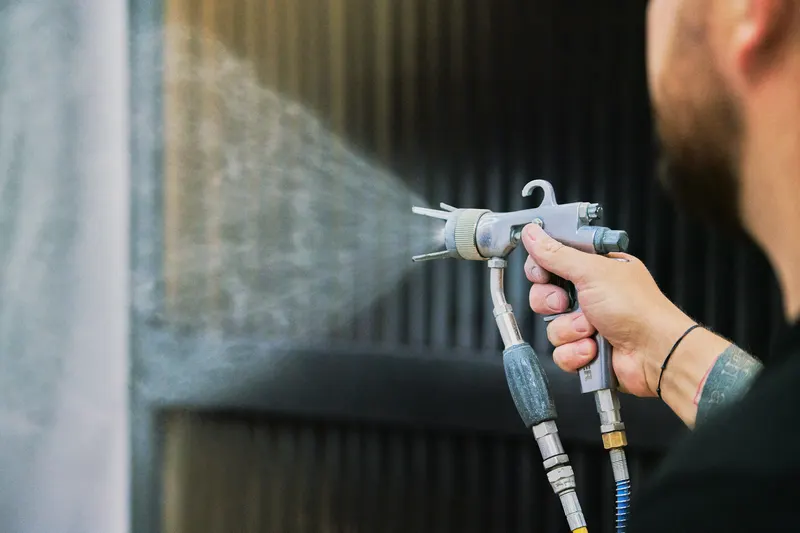
Thick, filled materials and heavy layers are exactly the job for Airless: a piston pump forces the material through the small orifice of the tip under high pressure and atomises it without air. The result is high output and a heavy layer in a single pass, even at a viscosity of several thousand mPa·s.
Choose the tip according to the material and the width of the surface; thicker and filled materials need a larger orifice. How to read the tip designation and when to replace it is explained in the article on choosing an Airless and AirCoat tip. Abrasive fillers (zinc, mica) wear the tip faster, so check it more often.
WAGNER PROTEC pumps and guns
For heavy-duty corrosion protection, WAGNER offers the PROTEC range. The piston pumps PROTEC 72-200 and PROTEC 95-150 reach a material pressure of up to 530 bar and are designed for large and for medium to large surfaces respectively, and for materials with high viscosity; the material temperature can be 5 – 80 °C. For very large surfaces there is the PROTEC 60-240 with a pressure of up to 480 bar. How to choose a pump by output and pressure is explained in the article on choosing a spray pump.
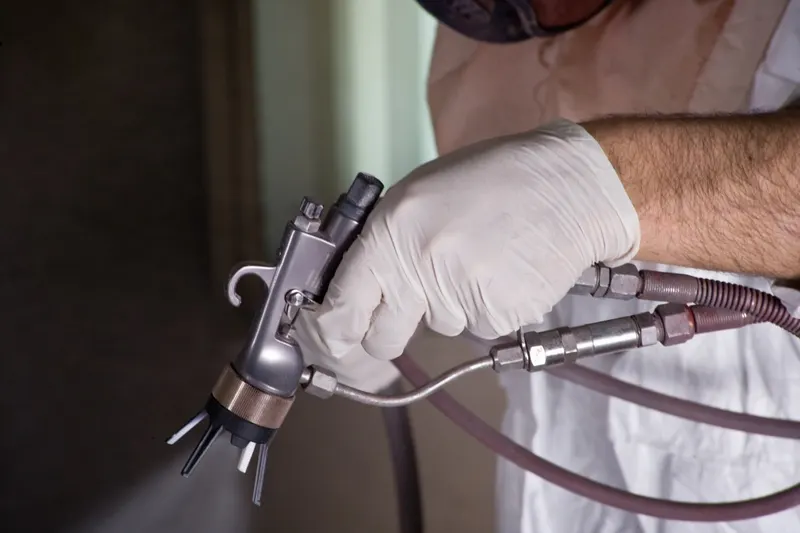
The PROTEC GM 1 airless manual spray gun is designed specifically for anti-corrosion and protective coatings on metal – zinc paints, high solids, 2K anti-corrosion paints, antifouling coatings and epoxy primers. It works with a material pressure of up to 350 bar and weighs 560 g, which makes a difference during a full day's work on large surfaces.
Test the material before the job
If you are changing the material or the layer thickness, bring a sample of the paint for a spray trial at the Industrial Coating Centre (showroom and test centre in Trnava). You will verify whether the pump and tip can handle the viscosity of your material and what layer you apply in one pass.
Is this an issue in your plant?
Tell us what you need – the technician for your area will get back to you.
Your technician
Peter Kovár
WAGNER Sales Manager | SK & CZ
- Phone – Peter Kovár: +421 911 804 818
- E-mail – Peter Kovár: kovar@
technikum.sk - Speaks: Slovak, Czech
Do you have a question on this topic?The AI adviser answers immediately
Your technician
Peter Kovár
WAGNER Sales Manager | SK & CZ
- Phone – Peter Kovár: +421 911 804 818
- E-mail – Peter Kovár: kovar@
technikum.sk - Speaks: Slovak, Czech
Frequently asked questions
What layers does heavy-duty corrosion protection consist of?
The system usually consists of three layers: a zinc-filled primer that protects the steel actively, an intermediate coat for mechanical resistance and adhesion, and a topcoat for appearance and UV resistance. The values in the table are approximate, taken from WAGNER training materials; for a specific material, the paint manufacturer's technical data sheet always applies.
How thick is a zinc primer?
The zinc primer lies directly on the steel. It is filled with zinc, or alternatively zinc phosphate or aluminium, and protects the steel actively – if the coating is damaged, the zinc corrodes instead of the steel as a sacrificial anode. It is usually applied at 70 – 150 µm, max. 500 µm. Since it serves mainly as a filler and sacrificial anode, its viscosity should not be high – according to WAGNER, max. 3,000 mPa·s.
Why are anti-corrosion coatings sprayed with Airless technology?
Thick, filled materials and heavy layers are exactly the job for Airless: a piston pump forces the material through the small orifice of the tip under high pressure and atomises it without air. The result is high output and a heavy layer in a single pass, even at a viscosity of several thousand mPa·s.
Have a different question? Write to us – a technician will answer. Send an enquiry
Technical terms are explained in the glossary.