Article
Spray booth and extraction wall: dry or wet (water) separation?
Published
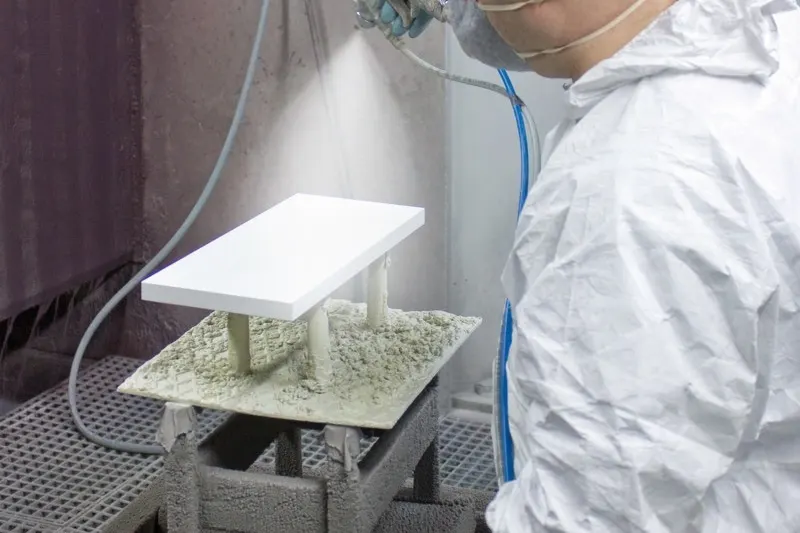
Extraction captures the paint mist that does not land on the part during spraying and separates it from the air either in filters or in water. Which method is suitable depends on the parts, the quantity and type of paint and the space you have in the paint shop.

What a spray booth and extraction are for
Extraction removes overspray from the workplace – the paint mist that does not land on the part during spraying. According to WALTHER PILOT, this helps reduce how much potentially harmful substances the worker inhales and keeps the workplace clean.
The extracted air carries paint droplets, so they must be separated before the air is discharged. This is called separation and is done in two ways: dry, where the paint is captured by multi-layer filter mats, and wet, where it is captured by water.
A paint shop is a typical potentially explosive environment, so the booth and the equipment in it must comply with ATEX rules. What zones mean and how they are determined is explained in the article ATEX in the paint shop.
How it works
How a spray booth with extraction works
The fan draws air from the working area. Overspray – paint particles that did not land on the part – is captured by filters or water, and the cleaned air is discharged outside.
Select a step or click a part of the diagram – we will show what it does, related terms, questions and products.
- Extracted air
Description of all parts
- Supply air
Air flows into the booth – on larger installations from a dedicated supply air unit that filters the air and heats it as required.
- Supply air
On larger installations, the supply air unit filters outside air, heats it as required and feeds it into the booth at a slight overpressure. On smaller booths, the air comes from the workshop.
The supply air must replace the extracted air, otherwise negative pressure and draughts occur. In the cold season, the supply air is heated.
- Supply air
- Working area
Spraying produces overspray. The air flow carries it away from the painter and the part.
- Booth working area
This is where the part is painted. The air flow carries overspray and vapours away from the painter.
Before commissioning, an explosion protection inspection is carried out, followed by regular inspections.
- Booth working area
- Overspray separation
Dry separation: multi-layer filter mats capture the overspray. Wet separation: the particles are bound in water, producing sludge.
- Dry filters
Multi-layer filter mats capture the overspray. On the 700/800 booths, for example, they are made of recycled paper in a hinged frame.
Advantages: lower investment, simpler disposal, no process water. Disadvantages: fire risk with self-igniting paints, downtime for filter changes and suction that varies as the filters clog. - Wet separation
In wet booths, the particles are bound in the scrubbing liquid, producing paint sludge.
Suitable for sticky and flammable paints, with a lower fire risk and constant performance. Disadvantages: humidity, corrosion, sludge disposal and chemicals.
- Dry filters
- Fan
A built-in fan creates the air flow through the booth.
- Fan
A built-in fan draws air through the filters.
- Fan
- Exhaust air
The cleaned air leaves through the exhaust air connection.
- Exhaust air
Exhaust air connection – on some booths it can be connected on the left or the right.
- Exhaust air
Simplified principle. We design the booth size, extracted air volume, type of separation and connection to the ventilation system according to the parts and material.
Source: WALTHER PILOT – WaltherWiki, extraction systems and supply air; type 700/800 booth pages (walther-pilot.de) and WAGNER Type 700 (wagner-group.com).
Dry separation: overspray captured by filters
In dry separation, the extracted air passes through multi-layer filter mats in which the paint is captured. More layers mean greater capacity and a longer filter life. Booths are therefore designed so that the filter can be changed quickly – for example via a hinged filter frame.
According to WALTHER PILOT, dry separation is cheaper to purchase, simple to operate, has low energy consumption and is suitable for both small and large quantities of overspray as well as for adhesives. It needs no water, so there is no water to change or clean, and the risk of bacterial and mould growth, corrosion of the structure and noise is reduced. Depending on the material and local regulations, used mats can often be disposed of as ordinary waste.
The drawbacks relate to the filter: it is a consumable that has to be bought and replaced, a change means downtime, and the extraction performance changes as the filter clogs. With self-igniting paint systems there is a risk of fire in the filter.
Wet separation: overspray captured by water
In wet separation, the paint droplets in the extracted air come into contact with water, bind to it, and the mixture is then separated from the air. For this to work, the contact area between water and air must be as large as possible – which is why wet booths create a water curtain. For example, the WALTHER PILOT type 5658 wet booth has one on three sides.
According to WALTHER PILOT, wet separation is particularly suitable for sticky or highly flammable paints. Water reduces the risk of fire, there is no filter to clog, so the extraction performance does not change, the separation is largely self-cleaning and there is less dust in the area. Self-igniting paints can be processed safely if the safety rules are followed.
The paint captured in the water forms sludge, which must be removed regularly. A coagulant helps with this – WALTHER PILOT wet booths optionally have a pump for dosing it and automatic water level control. The stainless steel WALTHER PILOT Twin 2200 sludge discharger removes floating sludge with a pneumatic scraper and an explosion-proof self-priming pump, and optionally has a diaphragm pump for sinking sludge. According to WALTHER PILOT, automatic sludge discharge makes it possible to process even very large quantities of paint.
Drawbacks of wet separation according to WALTHER PILOT: lower separation efficiency than a dry system (high efficiency requires a lot of energy), higher pressure drop, humid exhaust air, risk of rust on separator parts, wear of nozzles and pumps, costs of disposing of waste water and sludge, and the need for suitable chemicals. Water hygiene must also be considered.
Dry and wet separation compared
| Aspect | Dry (filters) | Wet (water) |
|---|---|---|
| What captures the overspray | multi-layer filter mats | water – water curtain |
| Purchase | cheaper | more expensive |
| Consumables | filter mats | coagulant, water; wear of nozzles and pumps |
| Extraction performance | changes as the filter clogs | does not change |
| Fire risk | in the filter with self-igniting paints | reduced by the water |
| Suitable materials | small and large quantities of overspray, adhesives | sticky and highly flammable paints, very large quantities of paint |
| Separation efficiency | higher | lower; high efficiency costs a lot of energy |
| Energy | low consumption | higher pressure drop, higher consumption |
| Waste | used mats | sludge and waste water |
| Maintenance | filter change, downtime | sludge discharge, water change, water hygiene, risk of corrosion |
Air supply: what is extracted must be replaced
Extraction draws large volumes of air out of the room, and if nothing replaces them, negative pressure develops. Air then flows in uncontrolled through openings and leaks, causing draughts and unstable airflow that affect both spraying and surface quality.
The air supply replaces the extracted air: it filters it, heats it as required and distributes it evenly without draughts. It usually maintains a slight overpressure in the booth so that unfiltered ambient air does not get in. According to WALTHER PILOT, the air should be heated when the temperature is below approximately 18 °C. Larger paint shops take air from outside; smaller and built-in installations can take it from the hall.
Extraction wall, booth or extraction table
The type of extraction is chosen according to the parts and how they reach it. Examples from the WALTHER PILOT and WAGNER range:
- open extraction wall – the part stands or hangs in front of the extraction surface; WALTHER PILOT type 90 W is made up of modules 1 m and 1.5 m wide to the required width, type 90 WS has sliding side walls and a roof for better airflow around the parts
- wall with a fixed front section – WALTHER PILOT type 90 K separates the painting workplace from the rest of production, optionally with a slot for crane loading
- compact booth on a table – for small and medium-sized parts on a work table or turntable (WALTHER PILOT type 77, 700/800, 80; WAGNER type 700 with dry multi-layer filtration)
- extraction table – extracts downwards, away from the worker; WALTHER PILOT type 25 for long parts such as mouldings, type 2000 for bonding
- mobile wall – WALTHER PILOT Ultra on a wheeled chassis for occasional work such as spot repairs
- wet wall – WALTHER PILOT type 6022 for long and bulky parts, including from an overhead conveyor
Questions to ask when choosing
- How large are the parts and how do they reach the extraction – by hand, on a turntable, on a conveyor, by crane?
- How much paint is sprayed and how much overspray is produced? This also depends on the spraying method.
- What material do you spray – standard paint, sticky or highly flammable paint, a self-igniting system, adhesive?
- How much space do you have, how wide must the wall be, will the equipment fit through the door, and does painting need to be separated from production?
- Where will the make-up air come from, and does it need to be heated in winter?
- How will you dispose of waste – used filters, or sludge and waste water?
How to choose a booth and extraction
If you are planning a new booth or extraction system, write down your answers to the questions above – part size, quantity and type of paint, space and air supply. With these, a suitable type can be selected from the WALTHER PILOT extraction walls and booths and a decision made between dry and wet separation.
Is this an issue in your plant?
Tell us what you need – the technician for your area will get back to you.
Your technician
Peter Kovár
WAGNER Sales Manager | SK & CZ
- Phone – Peter Kovár: +421 911 804 818
- E-mail – Peter Kovár: kovar@
technikum.sk - Speaks: Slovak, Czech
Do you have a question on this topic?The AI adviser answers immediately
Your technician
Peter Kovár
WAGNER Sales Manager | SK & CZ
- Phone – Peter Kovár: +421 911 804 818
- E-mail – Peter Kovár: kovar@
technikum.sk - Speaks: Slovak, Czech
Frequently asked questions
How does dry overspray separation work?
In dry separation, the extracted air passes through multi-layer filter mats in which the paint is captured. More layers mean greater capacity and a longer filter life. Booths are therefore designed so that the filter can be changed quickly – for example via a hinged filter frame.
How does wet overspray separation work?
In wet separation, the paint droplets in the extracted air come into contact with water, bind to it, and the mixture is then separated from the air. For this to work, the contact area between water and air must be as large as possible – which is why wet booths create a water curtain. For example, the WALTHER PILOT type 5658 wet booth has one on three sides.
Why does a spray booth need an air supply?
Extraction draws large volumes of air out of the room, and if nothing replaces them, negative pressure develops. Air then flows in uncontrolled through openings and leaks, causing draughts and unstable airflow that affect both spraying and surface quality.
Have a different question? Write to us – a technician will answer. Send an enquiry
Technical terms are explained in the glossary.