Article
Material heating and circulation: why paint temperature changes the result
Published
The same paint sprays differently in a cold workshop than in a warm one, because its viscosity changes with temperature. We explain how to keep the material temperature constant through heating, a temperature-controlled container, circulation and stirring, and what to watch out for.

Why material temperature matters
Temperature changes the viscosity of the material: warmer paint is thinner, colder paint thicker. Viscosity in turn influences the choice of pump, nozzle and pressure, so at a different temperature the same equipment setting behaves differently.
Material that is too thick is a common cause of a poor spray pattern and pulsation, as described in the article on spraying defects. According to WAGNER, viscosity also determines the choice of nozzle: the thicker the material, the coarser the filter it needs.
Material temperature is affected by both the storeroom and the workshop. WALTHER PILOT describes an underbody protective coating line where, because of the location of the equipment, 200-litre drums are heated in winter with electric heating jackets. According to WALTHER PILOT, heating the air is one of the usual tasks of a booth's air supply when it is cold outside.
Stable conditions can also be monitored. In a WAGNER reference from the Motor Classic paint shop, the paint supply is located in an air-conditioned mixing room, and temperature, humidity and viscosity are monitored continuously.
What an inline heater does
An inline heater heats the material on its way to the gun. It can be used with Airspray, Airless and AirCoat spraying as well as with rotary and electrostatic application. Heated material is thinner, so it often does not need as much thinning to reach the correct viscosity – always within the range permitted by the paint manufacturer.
WAGNER offers it as an optional accessory, for example for the TwinControl system together with frames, trolleys, gun flushing units and external mixers.
Material can also be temperature-controlled in the container. In MDG pressure tanks, the material can be temperature-controlled, stirred, degassed and level-monitored before and during processing. WALTHER PILOT double-jacketed tanks have an outer chamber with a heating or cooling medium so that the material is at the optimum processing temperature; constant stirring keeps the temperature uniform, and level and temperature measurement can be added.
What to watch out for when heating
- Temperature range of all components. Each piece of equipment has a permitted material temperature, for example according to WAGNER the PM 500 double diaphragm pump 4–90 °C, the Puma 3-600 piston pump 5–80 °C and the 2K Comfort mixing system 5–60 °C; the WALTHER PILOT Pilot XIII manual gun only up to 42 °C material temperature. The entire path to the gun must be able to withstand the heated material.
- Gun. With heated material, the handle also matters – WAGNER lists the PROTEC GM 1 manual Airless gun with an insulated handle as suitable for heated material.
- 2K materials. Heat shortens the pot life: a higher temperature does reduce viscosity, but it accelerates the reaction. If the components differ in viscosity, heating the thicker component can help mixing – more in the article on 2K materials.
- Explosive atmosphere. In a paint shop with zones, every piece of equipment, including the heater, must be approved for the zone in question. The temperature class indicates the maximum surface temperature of the equipment, which must remain below the ignition temperature of the atmosphere present – see the article ATEX in the paint shop.
Circulation: material constantly in motion
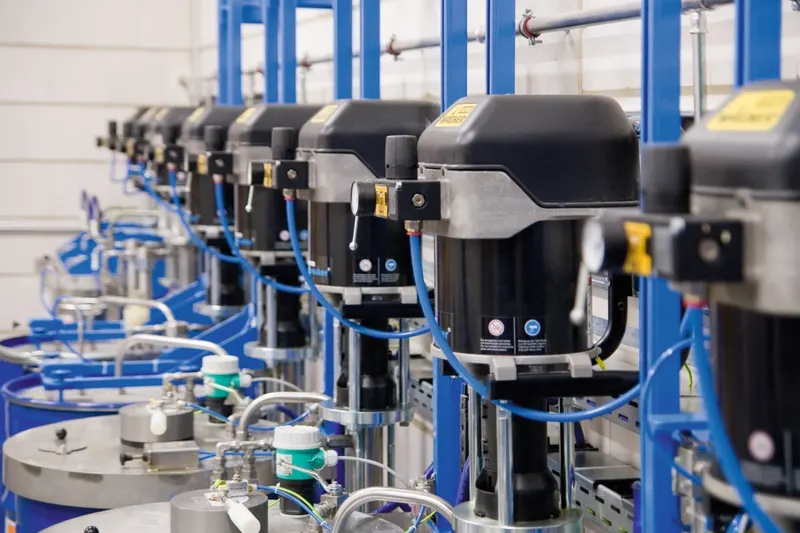
In circulation, the material continuously flows round a closed loop. This is easy to achieve with a pump; a pressure tank cannot manage it without an additional pump. According to WALTHER PILOT, a pump is therefore appropriate where high pressure, frequent material changes or circulation are needed.
Circulation is used mainly for materials that settle or dry quickly. WALTHER PILOT routes them this way, for example, in the ready-made System Select 4 and 6 systems, where the material is circulated by a double diaphragm pump.
With several guns and long hoses, pressure is decisive. The Unica double diaphragm pump with a 3.5:1 ratio is designed for thicker materials in long hoses and circulation loops; according to WAGNER, it can supply up to 16 Airspray guns. Thanks to the higher pressure, smaller hoses are sufficient, there is less unused material in the loop and, according to WAGNER, this saves material and time when changing colour and flushing.
The gun must also support the loop. The GA 4000 automatic spray gun can be mounted on base plates with or without circulation, the TOPFINISH GA 1900 has adapters with and without circulation, and the WALTHER PILOT Pilot XIII FA manual gun is available in a version with material circulation.
Agitator in the container
An agitator keeps the material in the container mixed. It may be pneumatic, electric or with a magnetic coupling. According to the manufacturer, the WALTHER PILOT Calix agitator for low to medium viscosity materials (up to 500 mPa·s) prevents rapid settling and shortens mixing time.
However, continuous stirring is not always an advantage. WALTHER PILOT describes a paint shop where paint was used from a 200-litre drum for too long: solvent evaporated through a leaking lid, and constant stirring accelerated the evaporation. In addition, around 15 litres usually remained in the drum for disposal. The solution was a switch to two 30-litre containers matched to daily consumption and intermittent stirring with electronically controlled speed.
Symptom, cause, solution
| Symptom | Possible cause | What to do |
|---|---|---|
| The surface or spray pattern differs between winter and summer, or during the day as the workshop temperature changes | the material temperature changes, and with it the viscosity | keep the material temperature constant – inline heater or temperature-controlled container; heated supply air in the booth |
| Poor spray pattern, pulsation | material too thick | adjust the viscosity by thinning according to the paint manufacturer's instructions or by heating – within the permitted temperature range of the equipment, and with 2K taking the shorter pot life into account |
| The 2K mixture thickens and sets sooner than you are used to | heat shortens the pot life | do not overheat the material, monitor the pot life and flush in good time |
| The material settles in the container or in the supply line | the material is stationary | agitator in the container, circulation by pump |
| Paint in the drum thickens, residues remain at the bottom | solvent evaporation through a leaking lid with constant stirring | smaller containers matched to daily consumption, intermittent stirring |
| Insufficient pressure with several guns and long hoses | a 1:1 pump is not sufficient for thick material | a pump with a pressure ratio, for example Unica 3.5:1 |
First measure the material temperature
If the result varies with the season or over the course of the day, it is worth first finding out the temperature of the material in the drum and at the gun. On that basis, you can decide between heating, a temperature-controlled container, an agitator or a circulation loop – we will be glad to help you choose a pump and accessories for your materials.
Is this an issue in your plant?
Tell us what you need – the technician for your area will get back to you.
Your technician
Peter Kovár
WAGNER Sales Manager | SK & CZ
- Phone – Peter Kovár: +421 911 804 818
- E-mail – Peter Kovár: kovar@
technikum.sk - Speaks: Slovak, Czech
Do you have a question on this topic?The AI adviser answers immediately
Your technician
Peter Kovár
WAGNER Sales Manager | SK & CZ
- Phone – Peter Kovár: +421 911 804 818
- E-mail – Peter Kovár: kovar@
technikum.sk - Speaks: Slovak, Czech
Frequently asked questions
How does temperature change the viscosity of paint?
Temperature changes the viscosity of the material: warmer paint is thinner, colder paint thicker. Viscosity in turn influences the choice of pump, nozzle and pressure, so at a different temperature the same equipment setting behaves differently.
What does a material inline heater do?
An inline heater heats the material on its way to the gun. It can be used with Airspray, Airless and AirCoat spraying as well as with rotary and electrostatic application. Heated material is thinner, so it often does not need as much thinning to reach the correct viscosity – always within the range permitted by the paint manufacturer.
When is material circulation worthwhile?
In circulation, the material continuously flows round a closed loop. This is easy to achieve with a pump; a pressure tank cannot manage it without an additional pump. According to WALTHER PILOT, a pump is therefore appropriate where high pressure, frequent material changes or circulation are needed.
Have a different question? Write to us – a technician will answer. Send an enquiry
Technical terms are explained in the glossary.
In this article
Products
- WAGNER Flow heater
- WAGNER Unica
- WAGNER PM 500
- WAGNER Puma 3-600
- WAGNER PROTEC GM 1
- WAGNER Material pressure tanks MDG
- WALTHER PILOT Special tanks
- WALTHER PILOT System Select 4
- WAGNER spray pumps and packages
- WAGNER suction and material preparation
- WAGNER pressure tanks
- WALTHER PILOT pressure and unpressurised tanks