Article
How much paint ends up off the part: transfer efficiency and how to increase it
Published
Part of the paint a paint shop buys never ends up on the part – it is captured by the extraction system and the booth filters. We explain what this proportion depends on, how it is affected by technology and settings, and how to calculate its cost easily.

What transfer efficiency and overspray are
Transfer efficiency is the proportion of paint that actually stays on the part. The rest is overspray – paint that misses the part and ends up in the air, in the extraction system or in the booth filter. These are two sides of the same thing: the higher the efficiency, the less overspray and the lower the paint consumption.
Efficiency is given as a percentage. With an efficiency of, say, 60 %, 0.6 litres of every litre stays on the part and 0.4 litres is lost. For the owner of the business, overspray is simply paint that has been paid for but cannot be sold on the product.
How the spraying method affects efficiency
The greatest influence is what atomises the paint. In conventional air spraying (Airspray), the paint is atomised by air at a pressure of 3 to 8 bar. According to WALTHER PILOT, this gives very fine atomisation, but also a lot of overspray and high material consumption.
HVLP works with atomising air of at most 0.7 bar, but in a large volume. According to WALTHER PILOT, it reduces overspray by up to 35 % and achieves a transfer efficiency of 65 %; the drawback is a lower area coverage rate. HVLP+ with air at 1 to 1.5 bar retains the advantages of low pressure and gives a better surface.
Airless and AirCoat atomise the paint by material pressure. AirCoat manages with a considerably lower pressure than Airless, and the assisting air at the nozzle refines the atomisation. According to WAGNER, the droplets travel more slowly, the spray jet is softer, with less paint mist and less overspray than with Airspray.
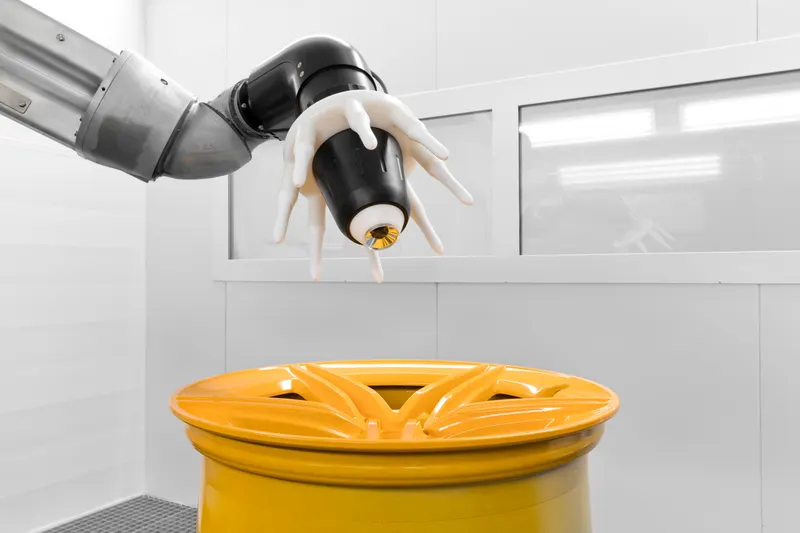
Electrostatic application can be added to Airspray, AirCoat and to a rotary atomiser. The charged droplets are attracted by the earthed part, and the paint wraps around it, reaching the rear side as well. According to WAGNER, GM 5000 manual electrostatic guns typically save 30 – 50 % of material compared with conventional spraying without electrostatics, and the RobotBell 1 ECH rotary atomiser achieves an efficiency of over 80 %, depending on material, flow rate and part. The conditions are explained in the article Electrostatic spraying of liquid paints; with water-based paint, electrostatic application requires an isolated system, as described in the article Water-based paints.
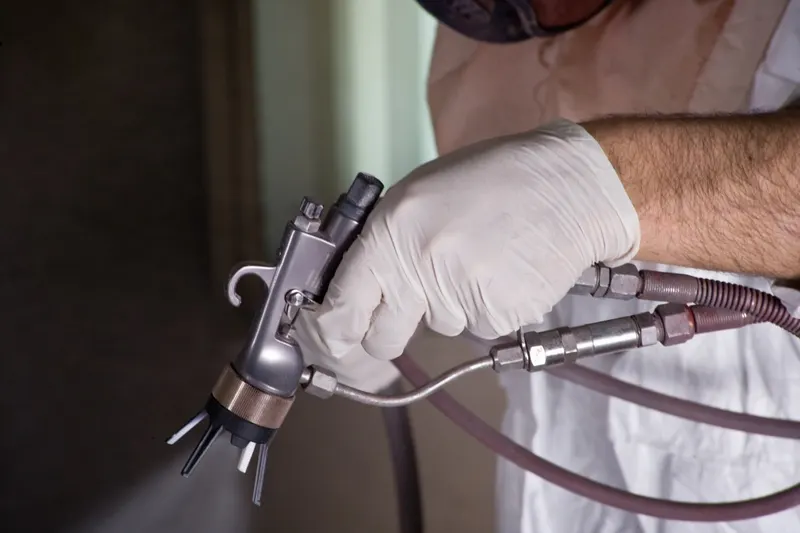
Even within one technology, guns differ in their air guidance and nozzle. For the TOPFINISH GM 1030 manual Airspray gun, WAGNER states an efficiency of up to 88 %, for the TOPFINISH GA 1900 automatic spray gun up to 85 % and for the GA 1020/1030 automatic spray guns up to 85 % (WALTHER PILOT; WAGNER now states up to 88 %). These are manufacturer figures for a specific model, not an average for the whole technology.
| Method | What atomises the paint | Effect on overspray | Manufacturer's figure |
|---|---|---|---|
| Conventional Airspray | air 3 – 8 bar | very fine atomisation, a lot of overspray | – |
| HVLP | air at most 0.7 bar in a large volume | less overspray, lower area coverage rate | up to 35 % less overspray, efficiency 65 % (WALTHER PILOT, general for the technology) |
| HVLP+ | air 1 – 1.5 bar | advantages of low pressure, better surface than HVLP | – |
| Airless | material pressure without air | unnecessarily high pressure increases overspray | – |
| AirCoat | material pressure and assisting air at the nozzle | softer spray jet, less overspray than Airspray | – |
| Electrostatic application (add-on) | charged droplets, earthed part | paint wraps around the part, including the rear | GM 5000: typically 30 – 50 % material saving; RobotBell 1 ECH: over 80 % (WAGNER) |
| TOPFINISH Airspray guns | air | optimised air guidance | GM 1030: up to 88 %; GA 1900: up to 85 % (WAGNER, highest value for a specific model) |
A dash in the table means that the manufacturers' public documentation does not give a general figure. Moreover, the data come from different sources and measurements, so treat them as indicative, not as a direct comparison.
What else matters: settings and the painter
The same gun can produce very different amounts of overspray depending on how it is set up and how it is used. The following have the greatest influence:
- Pressure – the right pressure is the lowest at which the material is still well atomised. According to WAGNER, unnecessarily high pressure leads to more overspray and faster wear of both the equipment and the nozzle.
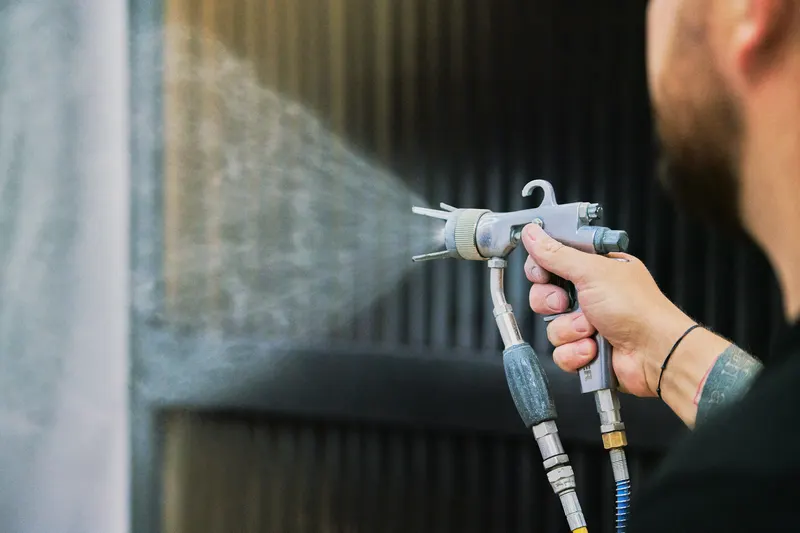
- Distance – if the gun is too far away, the spray jet widens, the layer becomes thinner and overspray increases; if it is too close, runs occur.
- Angle – hold the gun perpendicular to the surface; WAGNER also recommends this so that less paint mist remains in the air.
- Movement and overlap – only pull the trigger once your hand is moving, start off the part and overlap adjacent passes by approximately 30 %.
- Nozzle – choose the spray angle to suit the part: a narrow fan for frames and edges, a wide one for large surfaces. A worn nozzle sprays a poorer pattern with more overspray, and the wear cannot be seen from the outside.
- Part shape – according to WAGNER, the saving from electrostatic application is greatest with mesh-type and rounded parts; conversely, the electric field does not reach into cavities.
Step-by-step spray pattern adjustment and a table of defects with their causes can be found in the article The most common spraying defects.
What overspray costs besides the paint itself
You do not pay for overspray only through the price of the paint. Paint that misses the part must be captured by the extraction system and separated from the air – in a dry booth in filter mats, in a wet booth in water. This entails further costs:
- filters – mats are consumables, overspray clogs them and replacing them means downtime,
- cleaning – less paint mist means less contamination of the booth, hangers and equipment,
- waste – used filters and contaminated water must be disposed of according to the material and local regulations,
- emissions – according to WALTHER PILOT, low-pressure HVLP was developed precisely to limit volatile organic compounds (VOC).
The difference between dry and wet separation is explained in the article Spray booth and extraction wall.
Example calculation: how much paint higher efficiency saves
You can calculate the saving with a simple formula. The amount of paint that is to end up on the parts is determined by production; the only thing that changes is how much paint has to be bought for it:
- paint on the parts = paint consumption × transfer efficiency
- required consumption = paint on the parts ÷ transfer efficiency
An example with invented round numbers that do not belong to any specific technology: a paint shop uses 1,000 litres of paint a year at an efficiency of 50 %. 500 litres end up on the parts and another 500 litres are overspray. If the efficiency rose to 70 %, 500 ÷ 0.7 ≈ 714 litres would be enough for the same 500 litres on the parts. That is approximately 286 litres of paint less per year, and overspray falls from 500 to 214 litres.
For your own calculation, enter your annual consumption, the price per litre of paint and the efficiency verified by a trial on your part. Then add fewer filter changes, less cleaning and less waste to the paint saving.
- Paint saved per month
- –
- Paint saved per year
- –
- Savings per month
- –
- Savings per year
- –
- Payback
- –
How it is calculated
paint on parts = consumption per day × efficiency now · consumption after the change = paint on parts ÷ efficiency after the change
paint saved per month = (consumption per day − consumption after the change) × working days · per year = × 12
savings = paint saved × paint price · payback (months) = investment ÷ savings per month
An indicative calculation from your figures – it runs only in your browser and nothing is sent. It does not include the savings from less frequent filter changes, less cleaning and less waste described in the article.
The most reliable way to see the efficiency after the change is a trial on your own part with your own paint.
They will be inserted into the “What do you need” field, where you can see and edit them before sending.
Compare efficiency on your own part
Efficiency is most reliably compared on your own part with your own paint. Bring them for a spray trial to the Industrial Coating Centre (showroom and test centre in Trnava), where low-pressure, high-pressure and electrostatic spraying can be compared side by side. If changing technology also means reconsidering the paint feed, the article How to choose a spray pump will help.
Try it with your own material
Arrange a trial – you will see the result before you decide.
Your technician
Peter Kovár
WAGNER Sales Manager | SK & CZ
- Phone – Peter Kovár: +421 911 804 818
- E-mail – Peter Kovár: kovar@
technikum.sk - Speaks: Slovak, Czech
Do you have a question on this topic?The AI adviser answers immediately
Your technician
Peter Kovár
WAGNER Sales Manager | SK & CZ
- Phone – Peter Kovár: +421 911 804 818
- E-mail – Peter Kovár: kovar@
technikum.sk - Speaks: Slovak, Czech
Frequently asked questions
What are transfer efficiency and overspray?
Transfer efficiency is the proportion of paint that actually stays on the part. The rest is overspray – paint that misses the part and ends up in the air, in the extraction system or in the booth filter. These are two sides of the same thing: the higher the efficiency, the less overspray and the lower the paint consumption.
How does the spraying method affect transfer efficiency?
The greatest influence is what atomises the paint. In conventional air spraying (Airspray), the paint is atomised by air at a pressure of 3 to 8 bar. According to WALTHER PILOT, this gives very fine atomisation, but also a lot of overspray and high material consumption.
Have a different question? Write to us – a technician will answer. Send an enquiry
Technical terms are explained in the glossary.